
TheProNetBlog_Spring

Spring is in the air, and optimism surrounding the construction industry is at a new high!

We don’t want to kill the buzz, but this is as good a time as any to remember that your design firm isn’t impervious to crime-related loss or damage. Your insurance policy can (and should!) include a few specific coverages to protect you against things like Employee Dishonesty, Burglary, and Computer Fraud.

The following is an excerpt from our Typical Coverages for Design Professionals, and we hope it will educate you and give you some peace of mind:

COMMERCIAL CRIME COVERAGES

Commercial Crime Coverages include several separate insuring agreements. Some or all of these individual coverages may be selected, depending on the individual needs of a design firm:

Employee Dishonesty: This coverage pays for loss sustained by the insured employer up to a specified amount, caused by a dishonest act of an employee or employees covered under the policy. This includes dishonest acts of the embezzlement of money or property, including inventory, owned by the insured.

Forgery or Alteration: This coverage pays for loss sustained by the insured employer for forgery or alteration of checks (including blank checks) issued by the insured. Coverage may be extended to include checks forged or altered by employees as well as others. Continue reading “Commercial Crime Coverages for Architects & Engineers”

Tired of reading article after newsletter after white paper after blog post on risk management? (We hope not! But just in case…) Here’s another option:

[youtube https://www.youtube.com/watch?v=C2ioR9X05Qo]

Longtime a/e ProNet affiliate Kent Holland of ConstructionRisk, LLC has translated his impressive catalog of resources into a series of short videos available on the ConstructionRisk.com YouTube Channel.

“If you’re involved in the construction project, whether as a contractor, a designer, or a project owner, you will get real benefit from the practical ideas, suggestions, and law presented in these videos.”

A few of the playlists available now:

J. Kent Holland is a construction lawyer located in Tysons Corner, Virginia, representing design professionals, contractors, and project owners.

Don’t forget the popcorn!

PN - Vol. 21, No.2. 2013 - Building Information Modeling (BIM)Embracing the latest technology can set a design firm apart from the crowd, but it can also set you up for a rough road if you’re not adequately prepared beforehand. Building Information Modeling (BIM) is far from “new” at this point, but some wary design professionals have abstained from it anyway, allowing time to tell whether BIM would be a positive thing for the industry, overall. Good news!

“Building Information Modeling (BIM)… [has] not necessarily opened the door to more claims, as several carriers expected. A few [insurance companies] have found BIM projects to be low-risk; some even went as far as giving discounts to design clients that utilize BIM.” — Engineering, Inc., February 2014

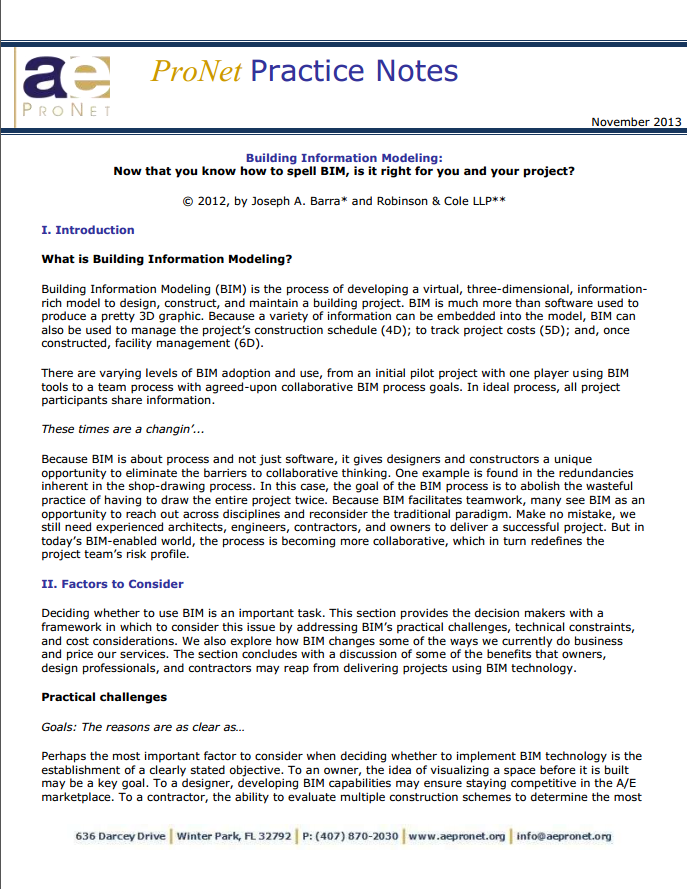
a/e ProNet’s latest ProNet Practice Note, authored by Joseph Barra of Robinson & Cole, can take you from here. The following is an excerpt from Building Information Modeling (BIM): Now that you know how to spell BIM, is it right for you and your firm?

Building Information Modeling (BIM) is the process of developing a virtual, three-dimensional, information rich model to design, construct, and maintain a building project. BIM is much more than software used to produce a pretty 3D graphic. Because a variety of information can be embedded into the model, BIM can also be used to manage the project’s construction schedule (4D); to track project costs (5D); and, once constructed, facility management (6D).

There are varying levels of BIM adoption and use, from an initial pilot project with one player using BIM tools to a team process with agreed-upon collaborative BIM process goals. In ideal process, all project participants share information.

These times are a changin’…

Because BIM is about process and not just software, it gives designers and constructors a unique opportunity to eliminate the barriers to collaborative thinking. One example is found in the redundancies inherent in the shop-drawing process. In this case, the goal of the BIM process is to abolish the wasteful practice of having to draw the entire project twice. Because BIM facilitates teamwork, many see BIM as an opportunity to reach out across disciplines and reconsider the traditional paradigm. Make no mistake, we still need experienced architects, engineers, contractors, and owners to deliver a successful project. But in today’s BIM-enabled world, the process is becoming more collaborative, which in turn redefines the project team’s risk profile.

To continue reading, download the full PDF version of this newsletter, which outlines Factors to Consider before deciding to use BIM (e.g., Type of Project, Timing, Teammates, Project Delivery Method). And if you have additional questions about BIM and/or professional liability insurance, be sure to contact your local a/e ProNet broker today!

EngineeringInc_aeProNetad_2014

Incredibly, even the global economic crisis hasn’t hardened the Professional Liability Insurance market for Architects and Engineers. Today, there are more insurance companies offering A&E policies than ever. And, thanks to the increasing insurance savvy of Design Professionals (particularly those utilizing the services of specialist brokers), new Professional Liability insurers are offering more in the way of risk management and pre-claims assistance, too.

You’ll find all this information and more outlined in the The Hard Market That Never Came, an analysis of the 2013 Professional Liability Insurance Survey of Carriers, in the February 2014 issue of Engineering, Inc. Continue reading “Engineering Inc. – 2013 Professional Liability Insurance Survey of Carriers”

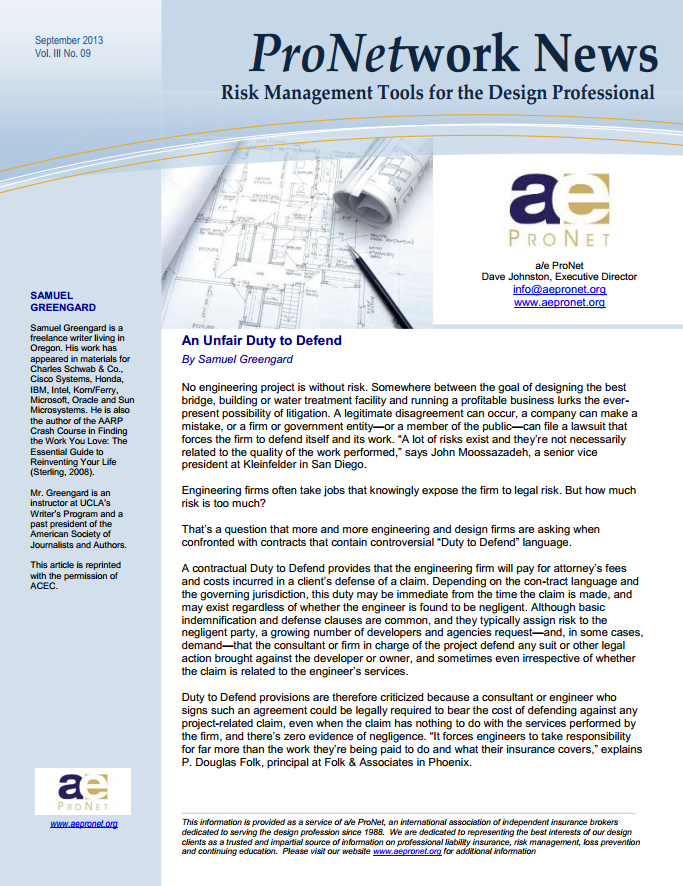
An Unfair Duty to Defend

pnn_unfairdutytodefendNo engineering project is without risk. Somewhere between the goal of designing the best bridge, building or water treatment facility and running a profitable business lurks the ever-present possibility of litigation. A legitimate disagreement can occur, a company can make a mistake, or a firm or government entity—or a member of the public—can file a lawsuit that forces the firm to defend itself and its work. “A lot of risks exist and they’re not necessarily related to the quality of the work performed,” says John Moossazadeh, a senior vice president at Kleinfelder in San Diego.

Engineering firms often take jobs that knowingly expose the firm to legal risk. But how much risk is too much?

That’s a question that more and more engineering and design firms are asking when confronted with contracts that contain controversial “Duty to Defend” language.

A contractual Duty to Defend provides that the engineering firm will pay for attorney’s fees and costs incurred in a client’s defense of a claim. Depending on the con-tract language and the governing jurisdiction, this duty may be immediate from the time the claim is made, and may exist regardless of whether the engineer is found to be negligent. Although basic indemnification and defense clauses are common, and they typically assign risk to the negligent party, a growing number of developers and agencies request—and, in some cases, demand—that the consultant or firm in charge of the project defend any suit or other legal action brought against the developer or owner, and sometimes even irrespective of whether the claim is related to the engineer’s services.

Duty to Defend provisions are therefore criticized because a consultant or engineer who signs such an agreement could be legally required to bear the cost of defending against any project-related claim, even when the claim has nothing to do with the services performed by the firm, and there’s zero evidence of negligence. “It forces engineers to take responsibility for far more than the work they’re being paid to do and what their insurance covers,” explains P. Douglas Folk, principal at Folk & Associates in Phoenix. Continue reading “An Unfair Duty to Defend”

contract

Why should I strike “breach of contract” from the indemnity provision in my agreement?

For one thing, it is redundant as there is already a remedy under the law should you breach your contract. Please note the excerpt in the next question from our Practice Notes Vol. 4 NO. 2, Indemnification: How to Identify Unacceptable Risks and Get Them Out of Your Agreements.

What is the significance of the statement in an agreement: “breach of any term or condition of this Agreement”?

Negligence may be difficult to prove, but breach of contract is not. To establish a breach, all an owner need do is prove that 1) you owed a duty to perform under your agreement, 2)you breached that duty, and 3) damages were sustained as a result. This is your client’s fall back position in the event negligence turns out to be impossible to establish. It is also your invitation to the owner to sue you at your expense. There is great leverage in this, and it flows in a single direction-from you to your client. Your client sues you for breach of contract, and you pay the associated attorneys’ fees and costs. Arguably, this is inconsistent with public policy. Public policy generally demands mutuality as a matter of equity where there is an agreement by one party to pay the attorney’s fees of another regardless of the outcome of a dispute between the two. Attorney’s fees are the only issue here, for if you are found to have breached your contract, there is a remedy for that in the law. As far as you are concerned, it is neither necessary, nor is it appropriate for you to add your indemnity to that remedy. Absent negligence your indemnification for breach of contact may be uninsurable; absent mutuality, it is unfair. Delete this language if you can. If you encounter sustained resistance, you might invoke the public policy argument and propose, as an alternative, to substitute language elsewhere in your agreement calling for the non-prevailing party to any dispute to compensate the prevailing party for costs of defense. There is leverage in this for you, but there is also some risk. Seek the advice of counsel before you pursue this strategy.

Excerpted from the FAQ page on the a/e ProNet website, one of many risk management resources for Architects & Engineers. Have any questions? Contact your local a/e ProNet broker or contact us directly today.

pronetworknews_august2013This issue of ProNetwork News is meant to serve as a basic reference guide to the property insurance coverages typically purchased by design firms. Last month we posted a companion piece, Insurance 101: The Things You Always Wanted to Know About Liability Coverage But Were Afraid to Ask.

We continue our overview of insurance products of interest to design professionals with this review of property coverages that may apply to the needs of your particular practice. As always, we encourage you to ask your broker what insurance is right for you.

BUSINESS PROPERTY INSURANCE

Whether you lease or own your office, you need to insure office equipment, furniture, fixtures, computer equipment, phone systems, fax/copiers, valuable papers and fine arts for fire, theft and water damage. Insuring these valuables for “replacement cost” on an “all-risk form” means that your business is most likely to be reimbursed properly for a covered loss. If you lease furniture and equipment, the lessor will require this coverage and will be designated as a “loss payee.” Landlords of rented property usually require their tenants to maintain property coverage for the rented space to cover improvements and betterments provided to the leaseholder.

Since most design firms are heavily dependent on computer systems, it is important to properly inventory equipment and software.. For example, the cost to reproduce plans and specifications kept on computer files is significant when considering the insured value of valuable papers and records. However, no limit of insurance is a substitute for reliable backup procedures.

Stand-alone IT coverage packages, including security breach, are evolving almost daily. They can cover both first party losses (yours) and third-party losses (those for which you may be liable to others). Ask your broker what products may best apply to your needs.

VALUABLE PAPERS INSURANCE

A/E firms have in their possession valuable papers and documents whose destruction would prove very costly. Maps, plans, specifications and books are some examples. All-risk protection is generally available excluding wear and tear, gradual deterioration and vermin. Certain valuable papers may be insured specifically, or “scheduled.” More commonly, a blanket limit is established to cover all valuable papers. Articles insured on a blanket basis are covered for their replacement cost. Scheduled items are covered on a valued basis even though it is not possible to replace them with like kind and quality. Continue reading “Insurance 102: Property Coverages for Architects & Engineers”
seisomogram_eq

In an effort to demystify some of the concepts and to provide a ready reference, a/e ProNet gathered some of its finest insurance minds and put together this list of typical coverages for design professionals. This is not intended to be an exhaustive source of information but rather a primer designed to answer basic questions and to put the reader on the right track if more information is needed. Today, we’ll touch on Earthquake insurance and Flood insurance for Architects and Engineers:

EARTHQUAKE COVERAGE

Earthquake hazards in the United States are commonly associated with Western States and in particular California, however in past history, significant earthquakes have occurred on other states including South Carolina, Missouri, Ohio and Alaska. Because in the mid-states of the US a significant earthquake hasn’t occurred for more than 100 years, people have become very complacent about a reoccurrence. Some experts say it’s not a matter of “if” but “when.” As a result of this casual attitude, a high percentage of real and personal property is not currently insured for this hazard. A further concern is that building structures in these mid-state areas are not constructed to resist earthquake damage such as most new construction in California and other western states are. Keep in mind that loss is not limited to the direct damage to property. Severe earthquake may interrupt public transportation, damage roads and bridges that prevent the movement of private vehicles. Many utilities including electricity, water, fuel gas, and sewage may be interrupted for long periods of time. Every firm would be well served to investigate Earthquake Coverage for their building and contents coverage, even though the risk of loss seems remote.

Most Earthquake coverage is written on a “Difference in Conditions” insurance form, attached to standard property policies. This form originally included a multitude of “All Risk” coverages offered with earthquake added as an insured peril. The evolution of this coverage form has changed the focus to coverage from “All Risks of Loss” to focus on earthquake, Sprinkler Leakage, and Flood and does not include landslide, subsidence or soil movement unless it is caused by Earthquake. Continue reading “Natural Disasters: Earthquake and Flood Protection for Architects & Engineers”

why do i need an insurance brokerAt our fall meeting last month, a panelist asked an important question:

Why is an insurance broker necessary for design professionals? Shouldn’t architects and engineers be able to access insurance companies and purchase Professional Liability policies directly?

Members of a/e ProNet are professional, independent brokers who serve the insurance needs of design professionals. Membership in our association is by invitation only, and members must be experienced and have a minimum number of design professional clients, as well as a minimum amount of premium volume. Our members must also provide their clients with services beyond the sale of a professional liability policy.

In addition to knowing the professional liability marketplace, they negotiate the best product at the best price for their clients. That negotiation happens every year at renewal time, and because our members are independent—not obligated to any one insurance company—they are in the best position to compare and contrast policies. Often, the time and expertise this process requires is underestimated by A/E clients. With a specialist broker, the A/E can rest assured that they have an advocate annually, both in relation to their bottom line and their exposure as a professional in a demanding and risky environment.

Most importantly, though, that advocacy doesn’t end when the renewal has been processed. The rest of the year, our members’ clients can count on their specialist brokers to provide services such as contract review, accredited continuing education, and other risk management services. Continue reading “Why should Architects & Engineers use a specialist Insurance Broker?”