aiabirdpurplegoldThe American Institute of Architects recently announced that its 2013 Jury of Fellows elevated 122 AIA members to its prestigious College of Fellows, an honor awarded to members who have made significant contributions to the profession. Subsequently, we are proud to announce that several a/e ProNet members have clients on this illustrious list!

Kurt Schindler of ELS Architecture (Berkeley, CA)

Martin A. Diaz-Yabor of Martin A. D. Yabor & Associates, Inc. (Miami, FL)

Kenneth D. Levien of Levien & Company (New York, NY)

Terrence O’Neal of Terrence O’Neal Architect, LLC (New York, NY)

Claire Weisz of WXY architecture + urban design (New York, NY)

Glenn Keyes of Glenn Keyes Architects (Charleston, SC)

Turan Duda with Duda/Paine Architects (Durham, NC)

Clive Wilkinson of Clive Wilkinson Architects (Los Angeles, CA)

William J. Worthen of UrbanFabrick (San Francisco Bay Area, CA)

Congratulations, lady and gentleman, on this well-deserved honor.

The 2013 Fellows will be honored at an investiture ceremony at the 2013 National AIA Convention and Design Exposition in Denver.

How can architects create, market, and scale knowledge for a competitive advantage? It’s all about Social Media.

http://www.youtube.com/watch?v=4NwDeeu8QTM

AIA National posted this excellent video in January. Presenter Brian Skripac outlines the various ways architects can (and should!) use social media. He dispels certain social media myths (social media won’t replace your website or the need for face-to-face networking) and clarifies the goals for architects who are active in social media:

  • Marketing & Networking
  • Firm & Individual Branding
  • Ideas & Inspiration
  • Thought Leadership
  • Firm Culture & Community
  • Corporate Memory
  • Internal Communications & Transparency

Skripac rightly points out that there are WAY too many social networks to choose from, so you shouldn’t feel the need to dive into all of them at once. The ones which seem to be most effective for professionals are Twitter, Facebook, LinkedIn, and possibly Pinterest. (a/e ProNet has a Pinterest board that we’re pretty proud of. Check us out!) He also gives a shout out to several design firms and organizations that seem to be getting it right: Perkins + Will, Gensler, HOK, BNIM, and AIA Pittsburgh.

We hope you find this info useful. And we’re always looking for good Architects, Engineers, and Design Industry affiliates to follow… if you are one, or know one, leave us a comment!

Follow us on Twitter @aeProNet or find us on Facebook today.

awardWe’re proud to announce that two architecture students have received the David W. Lakamp AIA Scholarship offered each year through a/e ProNet’s partnership with the AIA.

The American Institute of Architects (AIA) have selected William Hood and Jake DeNeui to receive the 2012 a/e ProNet scholarship. The program, initiated by a/e ProNet, a national association of insurance brokers who are committed to providing liability insurance and loss prevention to architects, is awarded to architecture students who demonstrate a particular interest in the principles of management in architecture practice. Hood and DeNeui will both receive $2,500 to use towards their tuition.

The a/e ProNet scholarship was initiated in 1990 by a/e ProNet and is open to third and fourth year undergraduates, as well as graduate students of architecture enrolled in a NAAB- accredited professional degree program. Submissions are reviewed by jury members of the AIA Practice Management Knowledge Community. Candidates were graded on their transcripts, letters of recommendations, and an essay on how they would resolve a project management dilemma.

To read their case study topic responses, please click here.

William Hood – The Cooper Union

Hood is currently pursuing a Bachelor of Architecture at the Irwin S. Chanin School of Architecture of The Cooper Union in New York City. He has worked as a model-maker with the architects Moorhead & Moorhead and Andrew Berman Architect, and as a marketing and communications manager for Van Alen Institute and Thomas Balsley Associates. In 2007, he graduated with Honors from the College of Social Studies at Wesleyan University in Middletown, Connecticut.

Jake DeNeui – Montana State University

DeNeui is a 22-year-old graduate student at Montana State University. His primary interests include martial arts, rock climbing, hiking and art. Jake’s other skills and interests include speaking Spanish, teaching and practicing martial arts, and actively sharing his faith in Jesus. He plans on working in civic architecture and someday owning his own firm.

You can learn more about the a/e ProNet Scholarship and eligibility here. A full list of past winners can be found on the a/e ProNet Scholarship page at our website. The next deadline for application submissions will be in November of 2013. Follow us on Twitter for scholarship alerts!

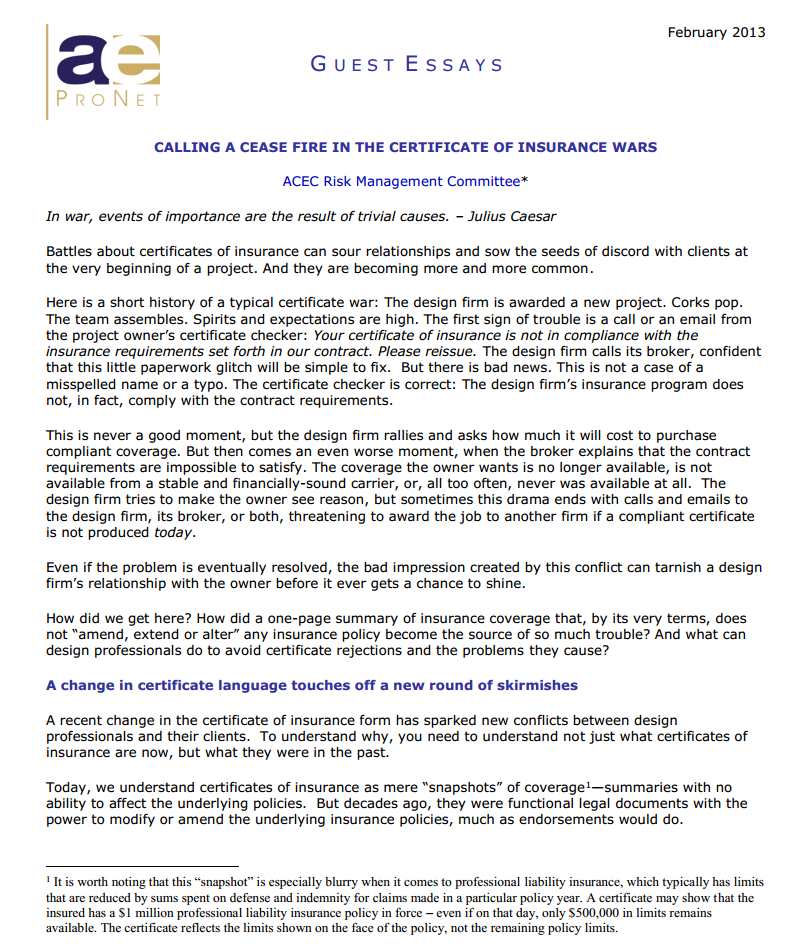
certwars_geThe following is an excerpt of the February 2013 a/e ProNet Guest Essay, Calling a Cease Fire in the Certificate of Insurance Wars. You may download the full PDF version of the newsletter on our website.

In war, events of importance are the result of trivial causes. – Julius Caesar

Battles about certificates of insurance can sour relationships and sow the seeds of discord with clients at the very beginning of a project. And they are becoming more and more common.

Here is a short history of a typical certificate war: The design firm is awarded a new project. Corks pop. The team assembles. Spirits and expectations are high. The first sign of trouble is a call or an email from the project owner’s certificate checker: Your certificate of insurance is not in compliance with the insurance requirements set forth in our contract. Please reissue. The design firm calls its broker, confident that this little paperwork glitch will be simple to fix.  But there is bad news. This is not a case of a misspelled name or a typo. The certificate checker is correct: The design firm’s insurance program does not, in fact, comply with the contract requirements.

This is never a good moment, but the design firm rallies and asks how much it will cost to purchase compliant coverage. But then comes an even worse moment, when the broker explains that the contract requirements are impossible to satisfy. The coverage the owner wants is no longer available, is not available from a stable and financially-sound carrier, or, all too often, never was available at all.  The design firm tries to make the owner see reason, but sometimes this drama ends with calls and emails to the design firm, its broker, or both, threatening to award the job to another firm if a compliant certificate is not produced today.

Even if the problem is eventually resolved, the bad impression created by this conflict can tarnish a design firm’s relationship with the owner before it ever gets a chance to shine.

How did we get here? How did a one-page summary of insurance coverage that, by its very terms, does not “amend, extend or alter” any insurance policy become the source of so much trouble? And what can design professionals do to avoid certificate rejections and the problems they cause? Continue reading “Calling a Ceasefire in the Certificate of Insurance Wars”

In 2013, Professional Liability insurance provider Victor O. Schinnerer will host independent subject-matter experts for four webinars, all geared toward Architects, Engineers, and other Design Professionals:

Computer-aj_aj_ashton_01.svgEmployment Liability Issues in a Recovering Economy

February 13, 2013, 1:00 – 2:00 pm eastern

Thomas L. McCally, Esq., Carr Maloney, P.C., Washington, DC

Design firms face various types of employment liability issues during the normal course of business. However, the downturn and subsequent recovery of the economy have brought these issues to the forefront of concerns for design firms. An attorney expert in litigating design firm employment practices claims will discuss the issues firms need to recognize as the economy improves and firms prepare to staff-up for the recovery.

Business Models and Financial Opportunities in a Recovering Economy

April 10, 2013, 1:00 – 2:00 pm eastern

Michael O’Brien, ASA, Rusk, O’Brien, Gido + Partners, Washington, DC

From funding sources to procurement procedures, the financial environment for professional services has significantly changed since the pre-recession economy. Both in the public and private sectors, the rules, risks, and routes to financial success are different. Professional services firms need to adjust their business plans to remain viable and to benefit from the opportunities in a recovering economy. Specializing in solving the business management and ownership challenges of consulting firms, our expert will share thoughts on the needs and responses of firms in the new service environment.

Technology Risks for Design Professionals

September 11, 2013, 1:00 – 2:00 pm eastern

David J. Shannon, Esq., Marshall, Dennehey, Warner, Coleman, Goggin, Philadelphia, PA

Technology risks associated with the business operations and professional services of design professionals is not new. However, the increased use of building information technologies and collaborative delivery methods, such as integrated project delivery, may increase the exposure of firms to traditional technology risks, as well as introduce new risks. Join our discussion with an attorney expert in technology risks to learn what exposures design firms need to be aware of and how to manage those exposures.

Insurance and Legal Questions for the Collaborative Design Team

October 9, 2013, 1:00 – 2:00 pm eastern

Rebecca H. Farnum, Esq., Thompson & Bowie, LLP, Portland, ME

Building information modeling and integrated project delivery provide a platform through which all members of the design and construction team collaborate. As with all new technologies and delivery methods, there are important questions the collaborating team should ask to identify and respond to legal and insurance issues in the open transfer of information in a contractual arrangement of shared risk and reward. Our expert will discuss what types of questions the team should ask before formally entering a collaborative agreement.

Visit our website to download the full PDF version of the 2013 Victor O. Schinnerer webinar schedule.


It’s true. The insurance industry has a reputation for bringing doom and gloom to an otherwise cheery outlook. Forgive us. Our business relies on our being able to spot negative trends in advance so that we can assist our clients in preparing for the worst. That doesn’t mean we don’t also hope for the best! Economic recovery is still ongoing, and we are thrilled that this means our architect and engineer clients are working and growing again.

That’s why, in our May 2012 post, To Hire or Not to Hire?, we mentioned some of the considerations and concerns facing design firms as they take on work that “could require additional hands,” including the need for accurate Professional Liability limits on their insurance policies… just a little worth-thinking-about-in-advance gloom.

Then this week, leading Professional Liability insurance provider, Victor O. Schinnerer, released its most recent Risk Management Guidelines, including an item on the Expanding Employment Liability Risks of recovering architecture and engineering firms.

“As firms downsized to face an economic downturn and restructured due to changing technology and new project delivery systems that required altered business models, employment practices claims rose. Add to that the challenges presented by the new generation of employees—many of whom consider their lives and the operations of their employers as public information, and a number of whom find the workplace to be a forum for their opinions—who are flooding the market during difficult economic times, and by returning military who must be accommodated in their former civilian positions or given preferential treatment, and firms are faced with a demanding and confusing employment perspective as they begin to staff up.”

Continue reading “Expanding Employment Liability Risks for Design Firms”

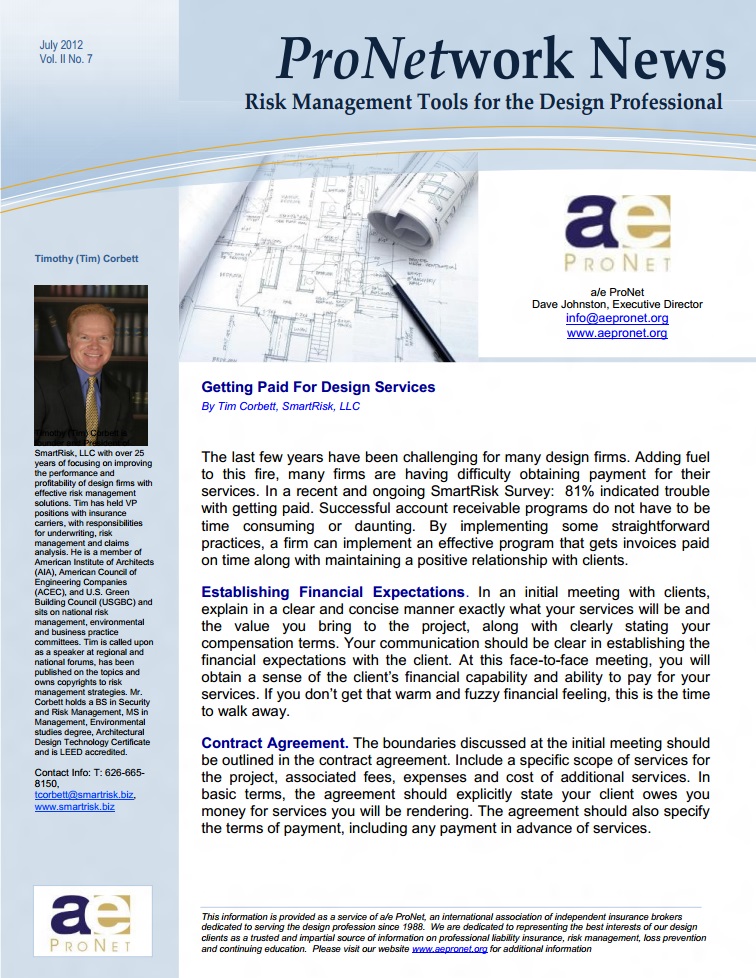
Getting Paid For Design Services

The last few years have been challenging for many design firms. Adding fuel to this fire, many firms are having difficulty obtaining payment for their services. In a recent and ongoing SmartRisk Survey: 81% indicated trouble with getting paid. Successful account receivable programs do not have to be time consuming or daunting. By implementing some straightforward practices, a firm can implement an effective program that gets invoices paid on time along with maintaining a positive relationship with clients.

Establishing Financial Expectations. In an initial meeting with clients, explain in a clear and concise manner exactly what your services will be and the value you bring to the project, along with clearly stating your compensation terms. Your communication should be clear in establishing the financial expectations with the client. At this face-to-face meeting, you will obtain a sense of the client’s financial capability and ability to pay for your services. If you don’t get that warm and fuzzy financial feeling, this is the time to walk away.

Contract Agreement. The boundaries discussed at the initial meeting should be outlined in the contract agreement. Include a specific scope of services for the project, associated fees, expenses and cost of additional services. In basic terms, the agreement should explicitly state your client owes you money for services you will be rendering. The agreement should also specify the terms of payment, including any payment in advance of services. Continue reading “Getting Paid For Design Services”

Attention, Architecture students! We know how hard you’re working toward your dream career, and we also know the cost of your education is high. Have you applied for the David W. Lakamp AIA Scholarship?

The David W. Lakamp AIA Scholarship was established in 1990 by a/e ProNet, a group of insurance professionals providing risk management services to architects and engineers. It was renamed in 1999 for David W. Lakamp, one of our founding members, and a widely-trusted advisor to the design industry. Mr. Lakamp left behind a legacy of professionalism and integrity that set new standards in the field of insurance services.

Today, the scholarship provides two $2,500 awards each year, and these are bestowed upon the two students who best demonstrate strong interest in practice management.

The scholarship is open to fourth-year undergraduates and graduate students of architecture enrolled in an NAAB-accredited professional degree program. Submissions are reviewed by a jury panel consisting of members of the AIA Practice Management Knowledge Community (PMKC) and the a/e ProNet organization. Candidates must submit a copy of their transcripts, two letters of recommendation, and an essay on how they would resolve a project management dilemma.

The current application deadline is November 19, 2012.

Visit the education section of the AIA website for more information, as well as to download a PDF of the 2012 a/e ProNet David W. Lakamp AIA Scholarship application.

In 2011, two recipients were awarded the a/e ProNet David W. Lakamp Scholarship. To read their case study topic responses, please click here.

Questions? Please send inquiries to: scholarships@aia.org

No Common Law Indemnification Duty Owed by General Contractor to Project Owner for Subcontractor Employee Injuries Where GC Did Not Control and Supervise the Subcontractor’s Work

In a case whose principles apply to design professionals as well as general contractors, a GC was performing a build-out for a store tenant (not the project owner) and retained the services of a subcontractor for certain work. An employee of the subcontractor was injured by falling from a ladder, and the project owner sued the contractor for common law indemnification and contractual indemnification for damages for which the Owner had been found vicariously liable under the state’s statutory law.

Although the general contractor had not itself been found to be directly liable or vicariously liable for the subcontractor employee injuries, the property owners argued they were entitled to common law indemnification. They asserted the general contractor contractually assumed sole responsibility and control of the entire project, and had the contractual authority to (1) direct, supervise and control the means and methods of plaintiff’s work, and (2) institute safety precautions to protect the workers.

The Owner asked the Court to adopt a general rule that a party may be liable for common-law indemnification upon a showing that the party (i.e., the proposed indemnitor) either was actually negligent or had the authority to direct, control or supervise the injury-producing work, even if it did not exercise that authority. What the Owner asked to court to do was equate a party that merely has authority to direct, control or supervise the work with a party who is actively at fault in bringing about the injury suffered by the plaintiff.

The appellate court held that in the absence of proof of any negligence or actual supervision of a general contractor, the mere authority the general contractor has to supervise the work and implement safety procedures is not a sufficient basis to require common law indemnification of the project owner. McCarthy v. Turner Construction, Inc., 953 N.E. 2d 794, (New York, 2011).

Although the GC interacted with the subcontractor and the sub-subcontractor firm whose employee was injured, the GC had no supervisory authority over the sub-subcontractor’s work and it provided no tools or ladders to subcontractors that worked at the site.

No Contractual Indemnification

Citing case law that stands for the proposition that through a contractual indemnification clause, an owner who is only vicariously liable by statute may seek full indemnification from the party that is wholly responsible for the accident, the court found in this case that there was no direct contractual relationship between the project owner and the general contractor. The contract was in fact between the contractor and a store tenant of the project owner. In addition, the owner had no third party beneficiary rights under the contract between the contractor and the store tenant. For these reasons, the contractual indemnification claim was dismissed on summary judgment by the trial court, and that dismissal was affirmed on appeal.

This has been an excerpt of the June 2012 edition of ProNetwork News. Download the full PDF version of this newsletter to read more about Common Law Indemnification and the implications for design professionals.

About the Author: J. Kent Holland is a construction lawyer with the risk management consulting firm Construction Risk Counsel, PLLC, in Tysons Corner – Vienna, Virginia. The firm provides consulting services including: Contract Risk Management and Insurability Review; Change Order and Claim Preparation and Analysis; Insurance Risk Management; Insurance policy and endorsement review and drafting; and Risk Management Training. Mr. Holland is admitted to practice law in Virginia and Maryland and concentrates on construction and environmental law, insurance and risk management. For more information, call 703-623-1932 or e-mail Kent@ConstructionRisk.com. This article is adapted from one originally published in ConstructionRisk.com Report, Vol. 14, No. 5 (May 2012). and is used here with permission.