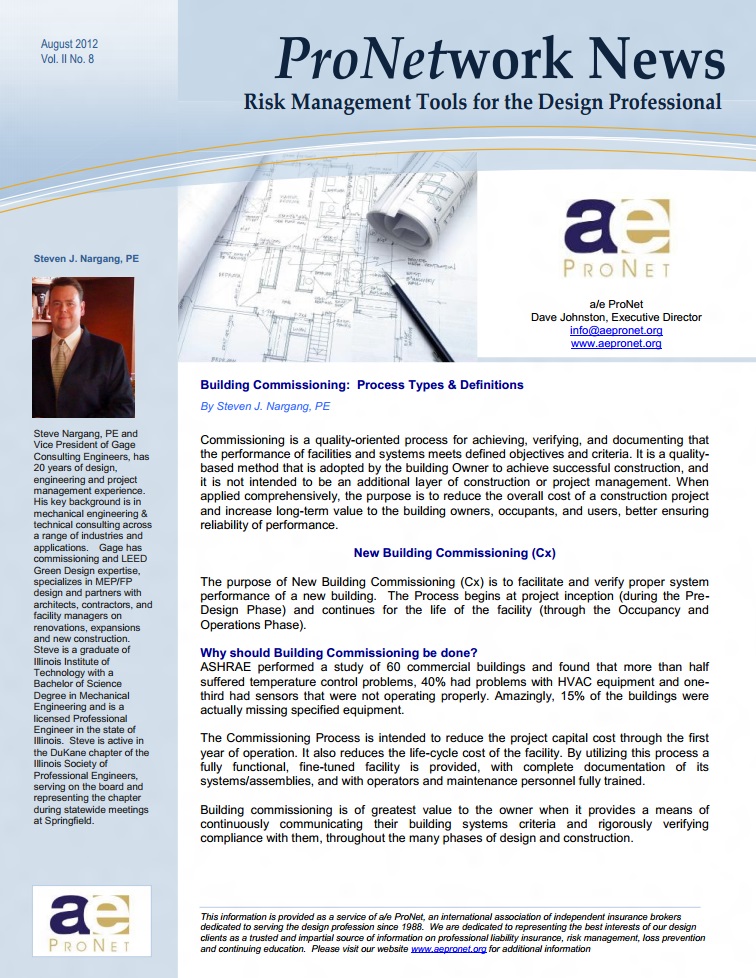
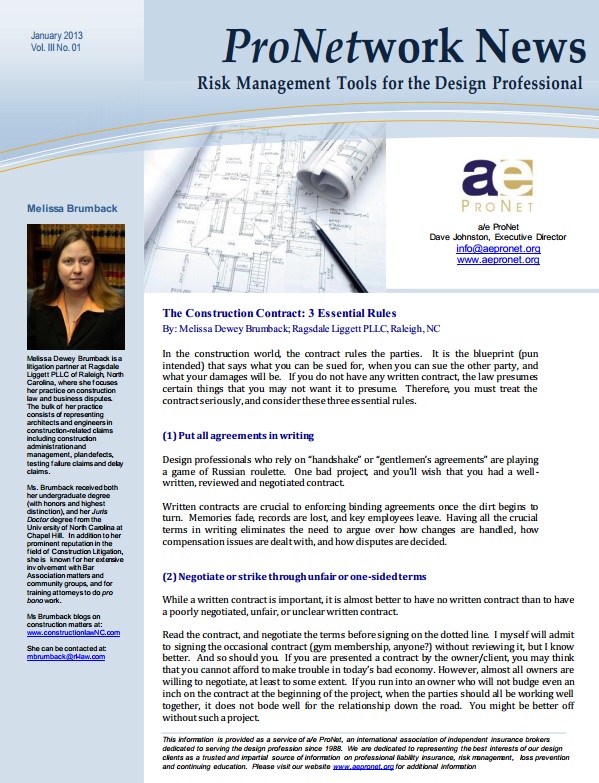
pronetworknews_201301For design professionals, it’s good business to have a solid, fair contract in place before you begin work on a project. So, what are the three essential rules of putting together a construction contract? Our January 2013 ProNetwork News newsletter has the answer:

In the construction world, the contract rules the parties. It is the blueprint (pun intended) that says what you can be sued for, when you can sue the other party, and what your damages will be. If you do not have any written contract, the law presumes certain things that you may not want it to presume. Therefore, you must treat the contract seriously, and consider these three essential rules.

  1. Put all agreements in writing
  2. Negotiate or strike through unfair or one-sided terms
  3. Deal with discrepancies between the Proposal for Services and the Contract

(1) Put all agreements in writing

Design professionals who rely on “handshake” or “gentlemen’s agreements” are playing a game of Russian roulette. One bad project, and you’ll wish that you had a well-written, reviewed and negotiated contract.

Written contracts are crucial to enforcing binding agreements once the dirt begins to turn. Memories fade, records are lost, and key employees leave. Having all the crucial terms in writing eliminates the need to argue over how changes are handled, how compensation issues are dealt with, and how disputes are decided.

(2) Negotiate or strike through unfair or one-sided terms

While a written contract is important, it is almost better to have no written contract than to have a poorly negotiated, unfair, or unclear written contract. Continue reading “The Construction Contract: 3 Essential Rules”

One of the many value added resources a/e ProNet brokers offer is access to our ProNet Practice Notes, in-depth white papers prepared by members of a wide variety of professions related to the design industry. They offer insight and advice on topics like risk management, practice management, and litigation issues for Architects, Engineers, and other Design Professionals.

ProNetPracticeNotes_Header

Our most recent edition is titled  The Collections-Claim Connection: Getting Paid Without Getting Sued, authored by attorney David A. Ericksen of Severson & Werson in San Francisco, CA. The full PDF version of this excellent paper, including several helpful attachments, is available for download at our website. The following is an excerpt for your review. We hope you find it helpful!

Introduction

While money isn’t everything, it is the measure and fuel of any business, including a design firm. Without payment for services firms suffer, starve, and even die. Payment issues are also often the single greatest warning sign of a project in trouble.

Perhaps there is no greater indicator of the correlation between unpaid fees and troubled projects and relationships than the remarkable frequency with which efforts of design professionals to collect unpaid fees through litigation result in even larger responsive counter-claims from clients alleging professional negligence. 2011 gave the entire industry the most dramatic and alarming example of this pattern. Having already received over $8.2M in fees, the engineering firm Carter & Burgess sued its client the City of Victorville in Southern California for the final $106,196 on a power plant project that the City had been forced to partially abandon mid-project due to cost overruns. The City responded with a counter-claim for professional negligence. When the verdict came in 2011, it was devastating financially and professionally as news, industry, and internet sources widely reported and publicized the award of $52.1M in damages against the engineering firm.

The results of such a counter-claim need not be as dramatic in terms of publicity or financial losses to be devastating to the firm. In addition to the unpaid fees, there are many other impacts of even a “defensive” counter-claim. They frequently include:

  • Deductible payments for legal fees and costs, which may even include the involvement of a second “defense” attorney.
  • Insurance impacts for rating, pricing, and loss history.
  • Lost internal time and resources for purposes of participation in defense.
  • Publicity and required disclosures in future responses to RFPs for claims history.
  • Potential uninsured exposure for prevailing party attorneys’ fees if negligence claims exceed fee claims.
  • Ultimate discounted or waived fees for expediency of resolving and closing claim.

Obviously, avoiding such collection challenges and the potential for responsive claims is critical to good business and project success.

In reality, a proper approach to collections closely resembles a proper regimen for personal health. Firms which get paid become and remain healthy and strong. Firms which do not get paid regularly and on time become malnourished and increasingly susceptible to disease. Just as health is a life-long process, financial success is a project-long process. The following discussion tracks the relevant phases and provides analyses and strategies for those various phases. Those phases are: Continue reading “{ProNet Practice Note} The Collections-Claim Connection: Getting Paid Without Getting Sued”

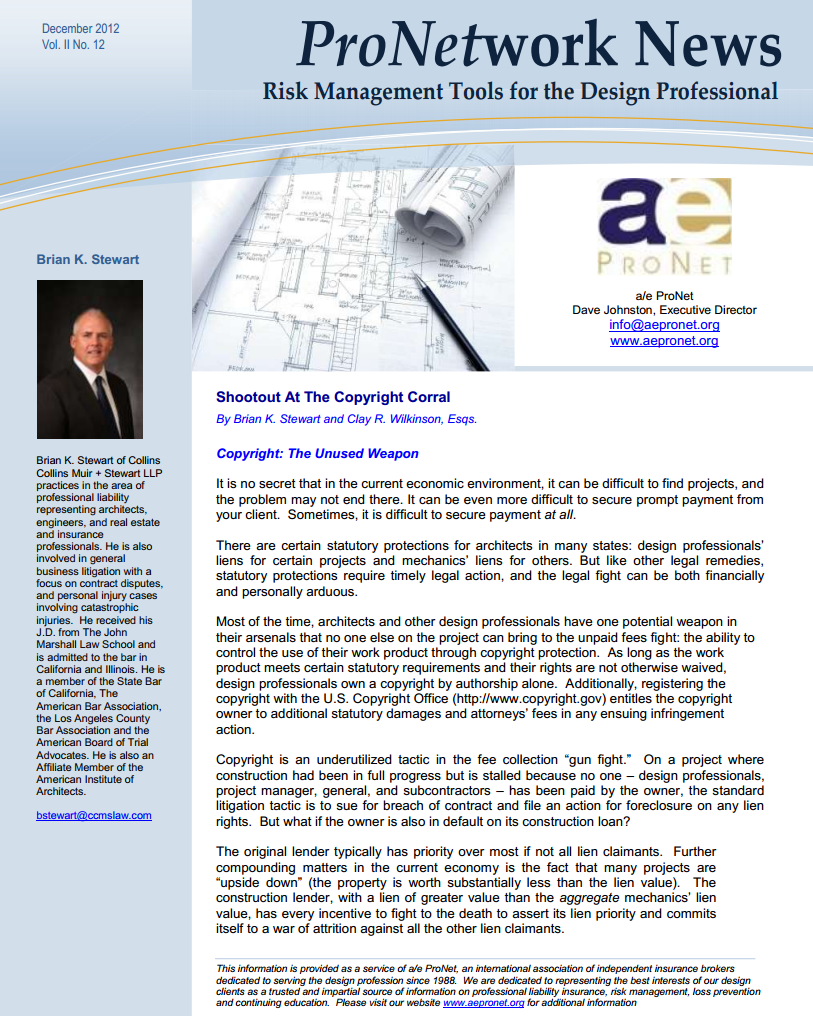
Shootout At The Copyright Corral

pronetworknews_dec2012Copyright: The Unused Weapon

It is no secret that in the current economic environment, it can be difficult to find projects, and the problem may not end there. It can be even more difficult to secure prompt payment from your client. Sometimes, it is difficult to secure payment at all.

There are certain statutory protections for architects in many states: design professionals’ liens for certain projects and mechanics’ liens for others. But like other legal remedies, statutory protections require timely legal action, and the legal fight can be both financially and personally arduous.

Most of the time, architects and other design professionals have one potential weapon in their arsenals that no one else on the project can bring to the unpaid fees fight: the ability to control the use of their work product through copyright protection. As long as the work product meets certain statutory requirements and their rights are not otherwise waived, design professionals own a copyright by authorship alone. Additionally, registering the copyright with the U.S. Copyright Office entitles the copyright owner to additional statutory damages and attorneys’ fees in any ensuing infringement action.

Copyright is an underutilized tactic in the fee collection “gun fight.” On a project where construction had been in full progress but is stalled because no one – design professionals, project manager, general, and subcontractors – has been paid by the owner, the standard litigation tactic is to sue for breach of contract and file an action for foreclosure on any lien rights. But what if the owner is also in default on its construction loan? Continue reading “Shootout At The Copyright Corral”

certwars_geThe following is an excerpt of the February 2013 a/e ProNet Guest Essay, Calling a Cease Fire in the Certificate of Insurance Wars. You may download the full PDF version of the newsletter on our website.

In war, events of importance are the result of trivial causes. – Julius Caesar

Battles about certificates of insurance can sour relationships and sow the seeds of discord with clients at the very beginning of a project. And they are becoming more and more common.

Here is a short history of a typical certificate war: The design firm is awarded a new project. Corks pop. The team assembles. Spirits and expectations are high. The first sign of trouble is a call or an email from the project owner’s certificate checker: Your certificate of insurance is not in compliance with the insurance requirements set forth in our contract. Please reissue. The design firm calls its broker, confident that this little paperwork glitch will be simple to fix.  But there is bad news. This is not a case of a misspelled name or a typo. The certificate checker is correct: The design firm’s insurance program does not, in fact, comply with the contract requirements.

This is never a good moment, but the design firm rallies and asks how much it will cost to purchase compliant coverage. But then comes an even worse moment, when the broker explains that the contract requirements are impossible to satisfy. The coverage the owner wants is no longer available, is not available from a stable and financially-sound carrier, or, all too often, never was available at all.  The design firm tries to make the owner see reason, but sometimes this drama ends with calls and emails to the design firm, its broker, or both, threatening to award the job to another firm if a compliant certificate is not produced today.

Even if the problem is eventually resolved, the bad impression created by this conflict can tarnish a design firm’s relationship with the owner before it ever gets a chance to shine.

How did we get here? How did a one-page summary of insurance coverage that, by its very terms, does not “amend, extend or alter” any insurance policy become the source of so much trouble? And what can design professionals do to avoid certificate rejections and the problems they cause? Continue reading “Calling a Ceasefire in the Certificate of Insurance Wars”

pronetworknews_nov2012If you have ever gone car or shoe shopping with and for someone else (teenagers and significant others, in particular), you know the difficulty and frustration that usually follows efforts to fit and style those with strong opinions and feelings on the subject. Such shopping is more an effort in very personal comfort, feel and perception than utility. The same can be true for design professionals’ scope of services. The most recent economy has left design professionals to suffer earliest, longest and hardest, particularly those that rely on residential development. To keep busy, some A/Es are marketing a broader scope of services, including services historically reserved for construction contractors. The comfort, feel and perception of such expanded scopes of services are highly personal but come with distinct and practical liabilities and risks. Like finding the right shoe size or vehicle type, A/Es can manage expanded risks with properly fitting contracts, insurance and professional structure.

SUV v. Sedan and Dress Shoe v. Cleats

In annual magazine reviews, sedans are compared to sedans and SUVs are compared to SUVs. The same is true of legal standards by which different roles are judged. A/Es provide a professional service and are compared to other A/Es by a standard of care – what others in the same profession are doing or would have done for a similar project. A/E contracts typically take care to adhere to recitations of the baseline standard of care and avoid or disclaim responsibility for means and methods, safety, warranties and the contractor’s timely or proper performance.

Contractors provide a finished product which is judged by a good and workmanlike standard: a warranty of quality, timeliness and, usually, safe performance of the work. Contractor agreements therefore give the contractor control over and responsibility for means and methods, safety, warranties, schedule and performance.

Crossovers and Hybrids

There is a line between trucks and cars, but there are luxury SUVs and crossovers to blur the line and offer compromises of varying degree.  The line between A/E services and contractor services has become equally fuzzy.  Try to explain in words the difference between the scope of services of a Construction Manager/Advisor, a Program Manager and an Owner’s Representative. For example:  The label is less important than the intended division of responsibility, control and money, and how that is expressed in a contract.  Continue reading “Architects Step Into Contractors Liability, Size XXL”

october_pronetwork_newsThe following is an excerpt of Part 2 in this two-part series. In Part 1, author Eric Singer covered Veni (I went to the site) and Vidi (I observed for general conformance with design intent).

Lis Pendens – I got sued anyway

Sometimes observable deficiencies get missed, or the timing, relative solvency or insured status of the parties and plain old bad luck conspire to force you to defend your compliance with the standard of care. In tort claims (injuries, property damage or other calamities), most states have procedural mechanisms to apportion fault among the parties or to add parties potentially at fault. Contract lawsuits are different and an owner could choose to pursue the A/E and leave the contractor alone or to settle and join forces with the contractor. In contract cases, many jurisdictions make it difficult for an architect to pursue claims against a contractor without a direct contract. You can defend by blaming the contractor’s “empty chair” or try a more aggressive approach. The general conditions may provide you with some ammunition.

General Conditions frequently contain a warranty in favor of both the owner and the architect. The AIA A201 (2007), for example, provides “The Contractor warrants to the Owner and Architect that materials and equipment furnished under the Contract will be of good quality and new unless the Contract Documents require or permit otherwise. The Contractor further warrants that the Work will conform to the requirements of the Contract Documents and will be free from defects, except for those inherent in the quality of the Work the Contract Documents require or permit.” (A201 – 2007, §3.5). Interpretation of this provision and rights of the architect in these circumstances varies greatly state to state. If viable in your state, a warranty claim against the contractor may prevent the owner and contractor from settling cheap or joining forces against the design team.

To read about Vici, I conquered, visit our website where you may download the full PDF version of this October 2012 issue (and all previous issues) of our ProNetwork Newsletters.

About the Author: Eric Singer is a partner at Ice Miller, LLP. He concentrates his practice in construction law, with emphasis on the representation of architects, engineers, contractors, owners, and lenders as well as other professionals, in litigation and alternative dispute resolution of design and construction issues. Mr. Singer, who was awarded his J.D by the University of Chicago Law School, is a former Professional Affiliate Director of the American Institute of Architects of Chicago and is a member of multiple bar associations and design professional groups. Recently ranked as AV Preeminent by Martindale-Hubbell and listed in The Best Lawyers of America, Construction Law, by those peer-review organizations, Eric is an active speaker and prolific author on the subject of construction litigation and the liability of the design professional. Contact Eric Singer at: eric.singer@icemiller.com

Don’t forget to contact your local a/e ProNet broker if you have any questions!

Excerpted from the September 2012 issue of ProNetwork News, part one of a two-part series:

pronetworknews_sept2012What if Caesar had written “I came to the project site, I observed for general conformance with the Contract Documents but not for means or methods or work covered since my last visit” and then wrote a three word report? Caesar was a master of understatement and understatement leads to misunderstandings and, well, understatement. Architects have always faced liability for undiscovered construction defects but current economic times have forced many contractors out of business. With the typical lack of contractor insurance for defective work, A/E’s are the only solvent or insured pocket, leaving design professionals more vulnerable to construction defect claims than in the past.

Veni – I went to the site

Those preaching risk reduction used to urge that architects and engineers leave construction administration to construction managers and contractors. This approach allowed or even encouraged contractors, CMs, program managers and owner’s representatives to take market share for services formerly performed by A/E’s. It also missed the point. Design professionals do not seek to eliminate liability, but to manage the reasonable risks of design practice. Reasonable risks are those placed with the party able to control them.

If an owner wants an A/E to ensure perfect construction, the project is doomed to fail for two reasons. First, there hasn’t been perfect construction since the Pyramids (and they had different labor and insurance agreements in those days). Second, the A/E does not control all of the variables that go into a construction project. There are elements of construction installed and concealed by the time the A/E arrives for a weekly or monthly meeting and site tour and even the most gifted A/E is powerless to see through walls. Continue reading “Veni, Vidi, Vici, Lis Pendens: I came, I saw, I got sued – Part 1 of 2”

Excerpted from the August 2012 issue of ProNetwork News:

Commissioning is a quality-oriented process for achieving, verifying, and documenting that the performance of facilities and systems meets defined objectives and criteria. It is a quality-based method that is adopted by the building Owner to achieve successful construction, and it is not intended to be an additional layer of construction or project management. When applied comprehensively, the purpose is to reduce the overall cost of a construction project and increase long-term value to the building owners, occupants, and users, better ensuring reliability of performance.

New Building Commissioning (Cx)

The purpose of New Building Commissioning (Cx) is to facilitate and verify proper system performance of a new building. The Process begins at project inception (during the Pre-Design Phase) and continues for the life of the facility (through the Occupancy and Operations Phase).

Why should Building Commissioning be done?

ASHRAE performed a study of 60 commercial buildings and found that more than half suffered temperature control problems, 40% had problems with HVAC equipment and one-third had sensors that were not operating properly. Amazingly, 15% of the buildings were actually missing specified equipment.

The Commissioning Process is intended to reduce the project capital cost through the first year of operation. It also reduces the life-cycle cost of the facility. By utilizing this process a fully functional, fine-tuned facility is provided, with complete documentation of its systems/assemblies, and with operators and maintenance personnel fully trained.

Building commissioning is of greatest value to the owner when it provides a means of continuously communicating their building systems criteria and rigorously verifying compliance with them, throughout the many phases of design and construction.

Prior to design, the Commissioning Authority (CxA) will assist the Owner in evaluating the facility’s requirements regarding such issues as energy conservation, indoor environment, staff training, and operation and maintenance. Continue reading “Building Commissioning: Process Types & Definitions”

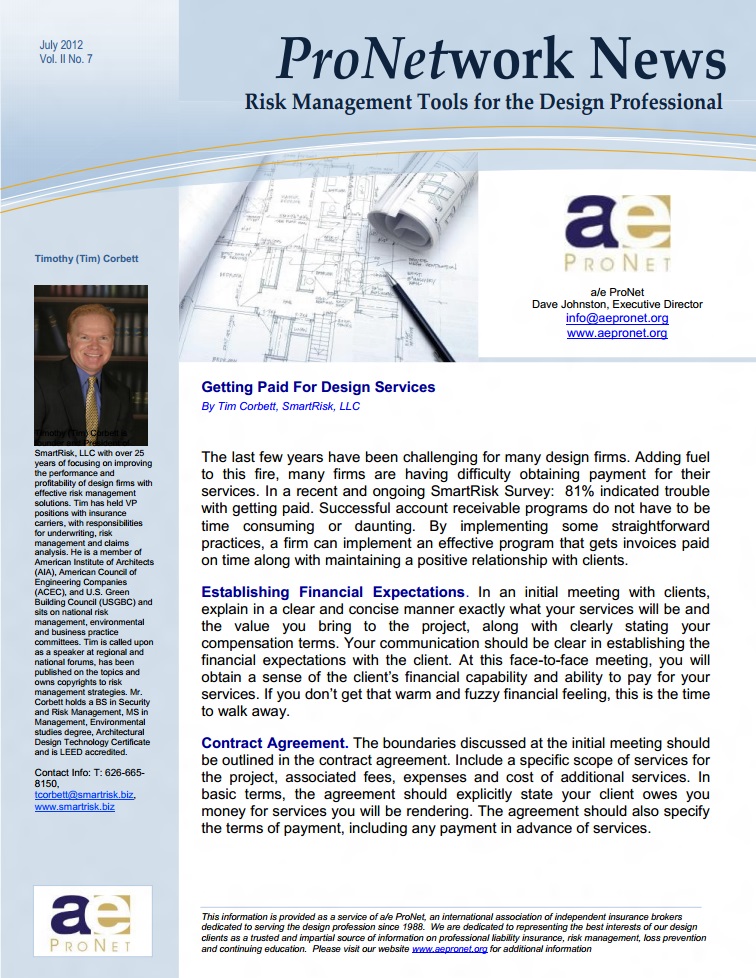
Getting Paid For Design Services

The last few years have been challenging for many design firms. Adding fuel to this fire, many firms are having difficulty obtaining payment for their services. In a recent and ongoing SmartRisk Survey: 81% indicated trouble with getting paid. Successful account receivable programs do not have to be time consuming or daunting. By implementing some straightforward practices, a firm can implement an effective program that gets invoices paid on time along with maintaining a positive relationship with clients.

Establishing Financial Expectations. In an initial meeting with clients, explain in a clear and concise manner exactly what your services will be and the value you bring to the project, along with clearly stating your compensation terms. Your communication should be clear in establishing the financial expectations with the client. At this face-to-face meeting, you will obtain a sense of the client’s financial capability and ability to pay for your services. If you don’t get that warm and fuzzy financial feeling, this is the time to walk away.

Contract Agreement. The boundaries discussed at the initial meeting should be outlined in the contract agreement. Include a specific scope of services for the project, associated fees, expenses and cost of additional services. In basic terms, the agreement should explicitly state your client owes you money for services you will be rendering. The agreement should also specify the terms of payment, including any payment in advance of services. Continue reading “Getting Paid For Design Services”