A steadily improving economy is spurring on construction activity in most regions of the county, and stimulating speculative development.
2012_ABIgraph

The following is an excerpt from the AIArchitect Blog post on the annual Architectural Billings Index report for 2012:

Final ABI for 2012 Caps Strongest Year Since 2007

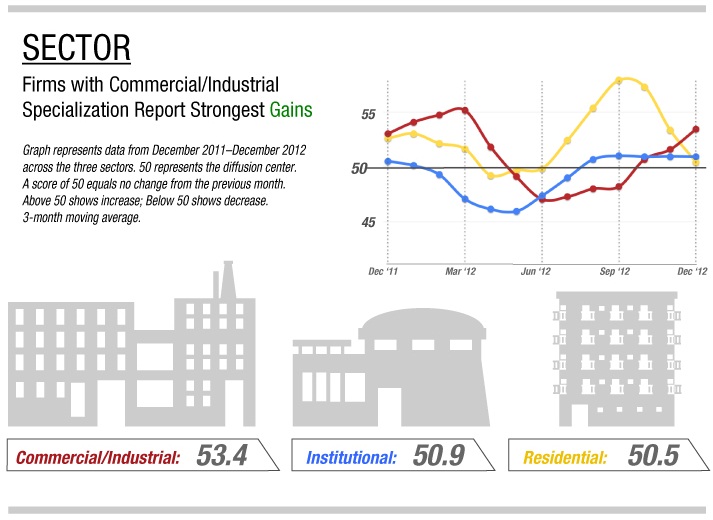
“Architecture firms continued to report improving business conditions in December, with an Architecture Billings Index (ABI) score of 52.0. (Any score above 50 represents billings growth). While the pace of billings growth slowed slightly from November, it is still the fifth consecutive month of growth, which means eight months of 2012 showed improving business conditions, the most in one calendar year since 2007. Inquiries into new projects remained strong, and firm backlogs for the fourth quarter inched up slightly from the third quarter to an average of 4.5 months.

Business conditions continued to improve at firms in all regions of the country in December with the exception of firms in the West, which continued to struggle to recover from nearly five years of declining billings. Firms located in the Midwest reported particularly strong firm billings last month after suffering a period of softness in the middle of the year. And for the third consecutive month, firms of all specializations reported experiencing increasing firm billings. The pace of growth has slowed significantly from the middle of the year for firms with a residential specialization, but continues to improve for firms with a commercial/industrial specialization.”

You know all this good news makes you want to read on… and you can! Visit the AIArchitect blog for the rest of it.”

Shout-Out Credit: 

Leslie Pancoast, CIC, RPLU
Past President of a/e ProNet
Managing Partner of IOA Insurance Services – Pleasanton, CA
Email: Leslie.Pancoast@ioausa.com / Phone: 925-416-7862

One of the many value added resources a/e ProNet brokers offer is access to our ProNet Practice Notes, in-depth white papers prepared by members of a wide variety of professions related to the design industry. They offer insight and advice on topics like risk management, practice management, and litigation issues for Architects, Engineers, and other Design Professionals.

ProNetPracticeNotes_Header

Our most recent edition is titled  The Collections-Claim Connection: Getting Paid Without Getting Sued, authored by attorney David A. Ericksen of Severson & Werson in San Francisco, CA. The full PDF version of this excellent paper, including several helpful attachments, is available for download at our website. The following is an excerpt for your review. We hope you find it helpful!

Introduction

While money isn’t everything, it is the measure and fuel of any business, including a design firm. Without payment for services firms suffer, starve, and even die. Payment issues are also often the single greatest warning sign of a project in trouble.

Perhaps there is no greater indicator of the correlation between unpaid fees and troubled projects and relationships than the remarkable frequency with which efforts of design professionals to collect unpaid fees through litigation result in even larger responsive counter-claims from clients alleging professional negligence. 2011 gave the entire industry the most dramatic and alarming example of this pattern. Having already received over $8.2M in fees, the engineering firm Carter & Burgess sued its client the City of Victorville in Southern California for the final $106,196 on a power plant project that the City had been forced to partially abandon mid-project due to cost overruns. The City responded with a counter-claim for professional negligence. When the verdict came in 2011, it was devastating financially and professionally as news, industry, and internet sources widely reported and publicized the award of $52.1M in damages against the engineering firm.

The results of such a counter-claim need not be as dramatic in terms of publicity or financial losses to be devastating to the firm. In addition to the unpaid fees, there are many other impacts of even a “defensive” counter-claim. They frequently include:

  • Deductible payments for legal fees and costs, which may even include the involvement of a second “defense” attorney.
  • Insurance impacts for rating, pricing, and loss history.
  • Lost internal time and resources for purposes of participation in defense.
  • Publicity and required disclosures in future responses to RFPs for claims history.
  • Potential uninsured exposure for prevailing party attorneys’ fees if negligence claims exceed fee claims.
  • Ultimate discounted or waived fees for expediency of resolving and closing claim.

Obviously, avoiding such collection challenges and the potential for responsive claims is critical to good business and project success.

In reality, a proper approach to collections closely resembles a proper regimen for personal health. Firms which get paid become and remain healthy and strong. Firms which do not get paid regularly and on time become malnourished and increasingly susceptible to disease. Just as health is a life-long process, financial success is a project-long process. The following discussion tracks the relevant phases and provides analyses and strategies for those various phases. Those phases are: Continue reading “{ProNet Practice Note} The Collections-Claim Connection: Getting Paid Without Getting Sued”

Some client love! a/e ProNet Member client Douglas Pancake Architects of Newport Beach, California recently received 3 Silver Awards at the NAHB Best of 50+ Housing Awards.

douglaspancakearchitects_NAHBawards

Congratulations!

Shout-Out Credit: 

Alicia K. Igram, AAI, VP & Branch Rep
Design & Consulting Liability Specialist
IOA Insurance Services – Aliso Viejo, CA
Email: Alicia.Igram@ioausa.com / Phone: 949-680-1789

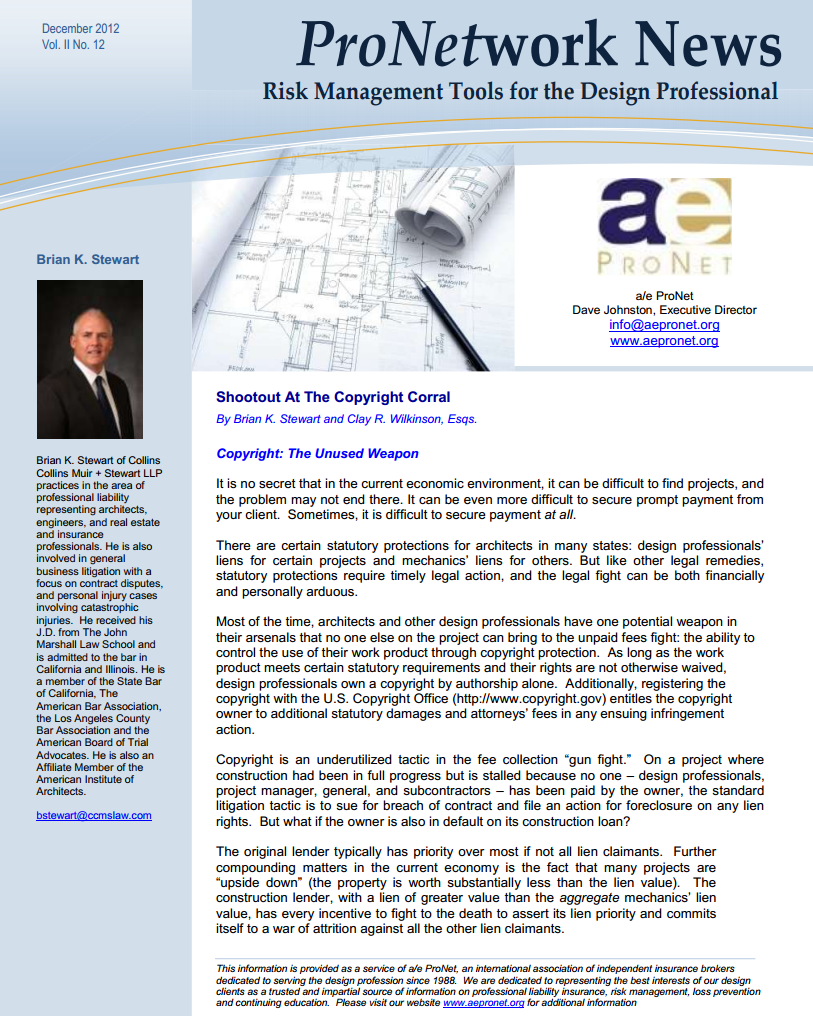
Shootout At The Copyright Corral

pronetworknews_dec2012Copyright: The Unused Weapon

It is no secret that in the current economic environment, it can be difficult to find projects, and the problem may not end there. It can be even more difficult to secure prompt payment from your client. Sometimes, it is difficult to secure payment at all.

There are certain statutory protections for architects in many states: design professionals’ liens for certain projects and mechanics’ liens for others. But like other legal remedies, statutory protections require timely legal action, and the legal fight can be both financially and personally arduous.

Most of the time, architects and other design professionals have one potential weapon in their arsenals that no one else on the project can bring to the unpaid fees fight: the ability to control the use of their work product through copyright protection. As long as the work product meets certain statutory requirements and their rights are not otherwise waived, design professionals own a copyright by authorship alone. Additionally, registering the copyright with the U.S. Copyright Office entitles the copyright owner to additional statutory damages and attorneys’ fees in any ensuing infringement action.

Copyright is an underutilized tactic in the fee collection “gun fight.” On a project where construction had been in full progress but is stalled because no one – design professionals, project manager, general, and subcontractors – has been paid by the owner, the standard litigation tactic is to sue for breach of contract and file an action for foreclosure on any lien rights. But what if the owner is also in default on its construction loan? Continue reading “Shootout At The Copyright Corral”

aiabirdpurplegoldThe American Institute of Architects recently announced that its 2013 Jury of Fellows elevated 122 AIA members to its prestigious College of Fellows, an honor awarded to members who have made significant contributions to the profession. Subsequently, we are proud to announce that several a/e ProNet members have clients on this illustrious list!

Kurt Schindler of ELS Architecture (Berkeley, CA)

Martin A. Diaz-Yabor of Martin A. D. Yabor & Associates, Inc. (Miami, FL)

Kenneth D. Levien of Levien & Company (New York, NY)

Terrence O’Neal of Terrence O’Neal Architect, LLC (New York, NY)

Claire Weisz of WXY architecture + urban design (New York, NY)

Glenn Keyes of Glenn Keyes Architects (Charleston, SC)

Turan Duda with Duda/Paine Architects (Durham, NC)

Clive Wilkinson of Clive Wilkinson Architects (Los Angeles, CA)

William J. Worthen of UrbanFabrick (San Francisco Bay Area, CA)

Congratulations, lady and gentleman, on this well-deserved honor.

The 2013 Fellows will be honored at an investiture ceremony at the 2013 National AIA Convention and Design Exposition in Denver.

How can architects create, market, and scale knowledge for a competitive advantage? It’s all about Social Media.

http://www.youtube.com/watch?v=4NwDeeu8QTM

AIA National posted this excellent video in January. Presenter Brian Skripac outlines the various ways architects can (and should!) use social media. He dispels certain social media myths (social media won’t replace your website or the need for face-to-face networking) and clarifies the goals for architects who are active in social media:

  • Marketing & Networking
  • Firm & Individual Branding
  • Ideas & Inspiration
  • Thought Leadership
  • Firm Culture & Community
  • Corporate Memory
  • Internal Communications & Transparency

Skripac rightly points out that there are WAY too many social networks to choose from, so you shouldn’t feel the need to dive into all of them at once. The ones which seem to be most effective for professionals are Twitter, Facebook, LinkedIn, and possibly Pinterest. (a/e ProNet has a Pinterest board that we’re pretty proud of. Check us out!) He also gives a shout out to several design firms and organizations that seem to be getting it right: Perkins + Will, Gensler, HOK, BNIM, and AIA Pittsburgh.

We hope you find this info useful. And we’re always looking for good Architects, Engineers, and Design Industry affiliates to follow… if you are one, or know one, leave us a comment!

Follow us on Twitter @aeProNet or find us on Facebook today.

awardWe’re proud to announce that two architecture students have received the David W. Lakamp AIA Scholarship offered each year through a/e ProNet’s partnership with the AIA.

The American Institute of Architects (AIA) have selected William Hood and Jake DeNeui to receive the 2012 a/e ProNet scholarship. The program, initiated by a/e ProNet, a national association of insurance brokers who are committed to providing liability insurance and loss prevention to architects, is awarded to architecture students who demonstrate a particular interest in the principles of management in architecture practice. Hood and DeNeui will both receive $2,500 to use towards their tuition.

The a/e ProNet scholarship was initiated in 1990 by a/e ProNet and is open to third and fourth year undergraduates, as well as graduate students of architecture enrolled in a NAAB- accredited professional degree program. Submissions are reviewed by jury members of the AIA Practice Management Knowledge Community. Candidates were graded on their transcripts, letters of recommendations, and an essay on how they would resolve a project management dilemma.

To read their case study topic responses, please click here.

William Hood – The Cooper Union

Hood is currently pursuing a Bachelor of Architecture at the Irwin S. Chanin School of Architecture of The Cooper Union in New York City. He has worked as a model-maker with the architects Moorhead & Moorhead and Andrew Berman Architect, and as a marketing and communications manager for Van Alen Institute and Thomas Balsley Associates. In 2007, he graduated with Honors from the College of Social Studies at Wesleyan University in Middletown, Connecticut.

Jake DeNeui – Montana State University

DeNeui is a 22-year-old graduate student at Montana State University. His primary interests include martial arts, rock climbing, hiking and art. Jake’s other skills and interests include speaking Spanish, teaching and practicing martial arts, and actively sharing his faith in Jesus. He plans on working in civic architecture and someday owning his own firm.

You can learn more about the a/e ProNet Scholarship and eligibility here. A full list of past winners can be found on the a/e ProNet Scholarship page at our website. The next deadline for application submissions will be in November of 2013. Follow us on Twitter for scholarship alerts!

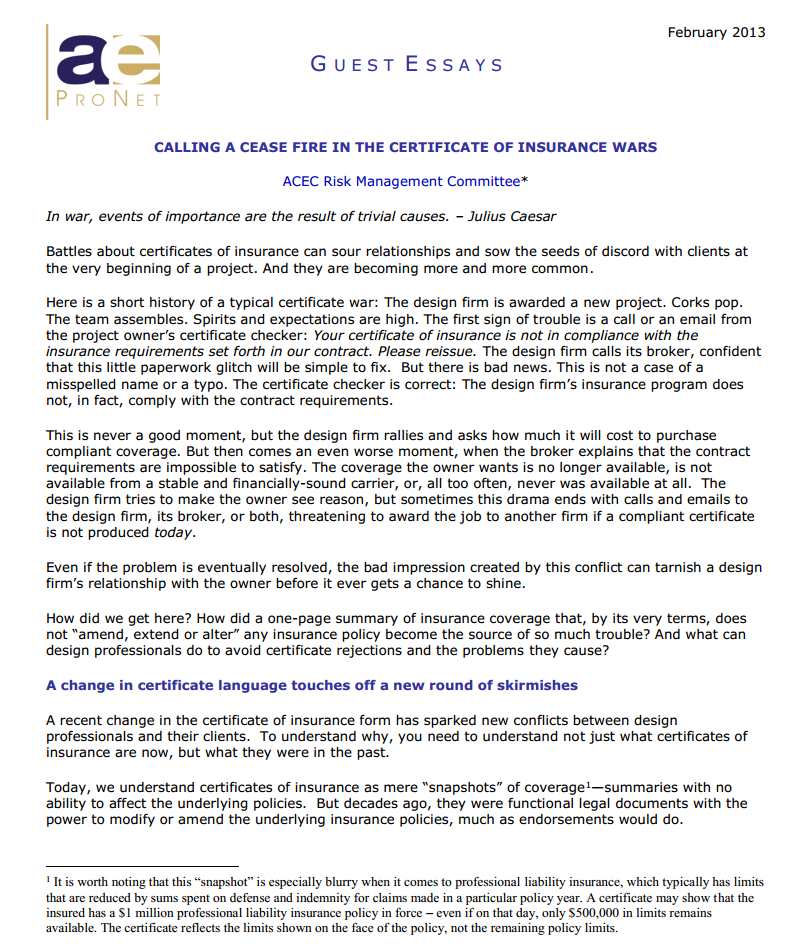
certwars_geThe following is an excerpt of the February 2013 a/e ProNet Guest Essay, Calling a Cease Fire in the Certificate of Insurance Wars. You may download the full PDF version of the newsletter on our website.

In war, events of importance are the result of trivial causes. – Julius Caesar

Battles about certificates of insurance can sour relationships and sow the seeds of discord with clients at the very beginning of a project. And they are becoming more and more common.

Here is a short history of a typical certificate war: The design firm is awarded a new project. Corks pop. The team assembles. Spirits and expectations are high. The first sign of trouble is a call or an email from the project owner’s certificate checker: Your certificate of insurance is not in compliance with the insurance requirements set forth in our contract. Please reissue. The design firm calls its broker, confident that this little paperwork glitch will be simple to fix.  But there is bad news. This is not a case of a misspelled name or a typo. The certificate checker is correct: The design firm’s insurance program does not, in fact, comply with the contract requirements.

This is never a good moment, but the design firm rallies and asks how much it will cost to purchase compliant coverage. But then comes an even worse moment, when the broker explains that the contract requirements are impossible to satisfy. The coverage the owner wants is no longer available, is not available from a stable and financially-sound carrier, or, all too often, never was available at all.  The design firm tries to make the owner see reason, but sometimes this drama ends with calls and emails to the design firm, its broker, or both, threatening to award the job to another firm if a compliant certificate is not produced today.

Even if the problem is eventually resolved, the bad impression created by this conflict can tarnish a design firm’s relationship with the owner before it ever gets a chance to shine.

How did we get here? How did a one-page summary of insurance coverage that, by its very terms, does not “amend, extend or alter” any insurance policy become the source of so much trouble? And what can design professionals do to avoid certificate rejections and the problems they cause? Continue reading “Calling a Ceasefire in the Certificate of Insurance Wars”

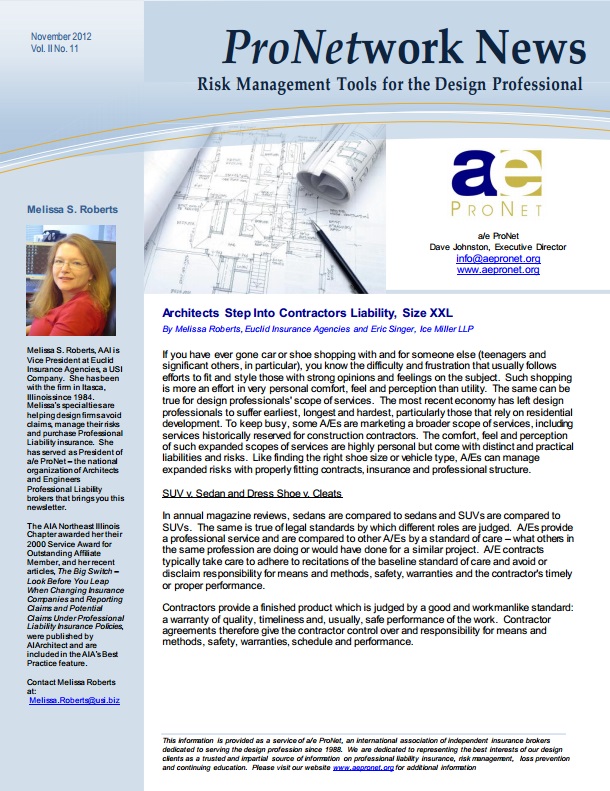
pronetworknews_nov2012If you have ever gone car or shoe shopping with and for someone else (teenagers and significant others, in particular), you know the difficulty and frustration that usually follows efforts to fit and style those with strong opinions and feelings on the subject. Such shopping is more an effort in very personal comfort, feel and perception than utility. The same can be true for design professionals’ scope of services. The most recent economy has left design professionals to suffer earliest, longest and hardest, particularly those that rely on residential development. To keep busy, some A/Es are marketing a broader scope of services, including services historically reserved for construction contractors. The comfort, feel and perception of such expanded scopes of services are highly personal but come with distinct and practical liabilities and risks. Like finding the right shoe size or vehicle type, A/Es can manage expanded risks with properly fitting contracts, insurance and professional structure.

SUV v. Sedan and Dress Shoe v. Cleats

In annual magazine reviews, sedans are compared to sedans and SUVs are compared to SUVs. The same is true of legal standards by which different roles are judged. A/Es provide a professional service and are compared to other A/Es by a standard of care – what others in the same profession are doing or would have done for a similar project. A/E contracts typically take care to adhere to recitations of the baseline standard of care and avoid or disclaim responsibility for means and methods, safety, warranties and the contractor’s timely or proper performance.

Contractors provide a finished product which is judged by a good and workmanlike standard: a warranty of quality, timeliness and, usually, safe performance of the work. Contractor agreements therefore give the contractor control over and responsibility for means and methods, safety, warranties, schedule and performance.

Crossovers and Hybrids

There is a line between trucks and cars, but there are luxury SUVs and crossovers to blur the line and offer compromises of varying degree.  The line between A/E services and contractor services has become equally fuzzy.  Try to explain in words the difference between the scope of services of a Construction Manager/Advisor, a Program Manager and an Owner’s Representative. For example:  The label is less important than the intended division of responsibility, control and money, and how that is expressed in a contract.  Continue reading “Architects Step Into Contractors Liability, Size XXL”