We’d like to congratulate Santa Monica architecture firm Koning Eizenberg on their recent win at the 2013 World Architecture Festival! They received the prestigious Housing Award for their 28th Street Apartments project in Los Angeles, California.

koning_eizenberg

The World Architecture Festival, held in Singapore earlier this month, gathered over 1,750 architects from around the world to exchange ideas and inspiration for design. This year, only 15 of the 260 shortlisted projects were from the USA, and Koning Eizenberg was the only American firm to receive an award.

Referring to the 28th Street Apartments, the judges noted: “This project demonstrates architecture as an agent for social transformation. The architect was able to knit together historical continuity and something very new, something of high architectural value.”

Koning Eizenberg’s website describes the project this way: “The restoration and expansion of a landmark YMCA built in 1926 restores principal spaces, reconfigures original housing, and innovatively adds replacement units. The design re-establishes this building’s role as an important community focus and brings living quarters in compliance with contemporary standards.” Read more on their website.

It’s so exciting to see our members’ clients set themselves apart on the world stage this way. Well done, Koning Eizenberg!

Shout-Out Credit:

Alicia K. Igram, AAI, VP & Branch Rep
Design & Consulting Liability Specialist
IOA Insurance Services – Aliso Viejo, CA
Email: Alicia.Igram@ioausa.com / Phone: 949-680-1789

For Monday, a few jokes about our favorite professionals… architects & engineers:

aecartoon

After working with our design staff for months on the renovation of an existing building for our office, we asked ourselves, “How many architects does it take to design an architect’s office?” The answer: too many! — Linda Derivi, AIA

When a surgeon makes a mistake they bury the patient. When an architect makes a mistake all one can do is plant vines. — Tim Stormont

An architect is said to be a man who knows a very little about a great deal and keeps knowing less and less about more and more until he knows practically nothing about everything, whereas, on the other hand, an engineer is a man who knows a great deal about very little and who goes along knowing more and more about less and less until finally he knows practically everything about nothing. A contractor starts out knowing practically everything about everything, but ends up by knowing nothing about anything, due to his association with architects and engineers. — AglaiaDaae

The optimist says the glass is half full. The pessimist says the glass is half empty. The engineer says the glass is twice the size it needs to be. — MukMan

Inspired by a recent post on the AIA California Council blog.

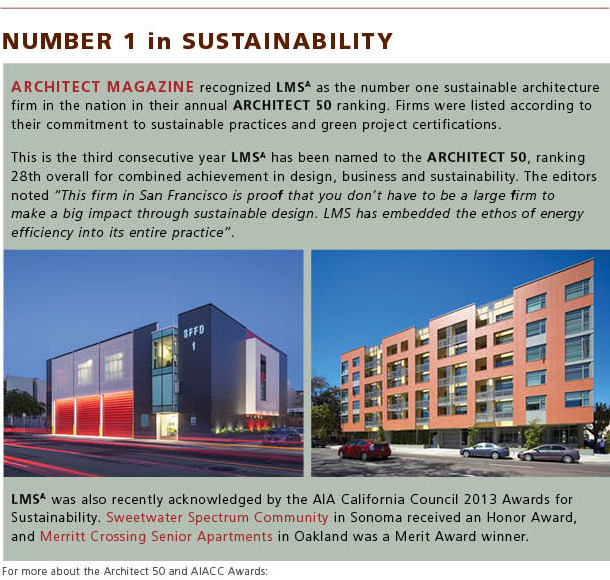
a/e ProNet client Leddy Maytum Stacy Architects of San Francisco has been named to Architect Magazine’s Architect 50 again, and this time they’ve received a top honor!

lms_greenarchitect

Earlier this year, we blogged one of LMSA’s award-winning sustainable projects, the Merritt Crossing Senior Apartments in Oakland, California.

Find out more about the Architect 50 at Architect Magazine’s website, including the Top 50 Business, Top 50 Design, and Top 50 Sustainability.

Congratulations, LMSA!

Shout-Out Credit: 

Leslie Pancoast, CIC, RPLU
Managing Partner
IOA Insurance Services – Pleasanton, CA
Email: Leslie.Pancoast@ioausa.com / Phone: 925-416-7862

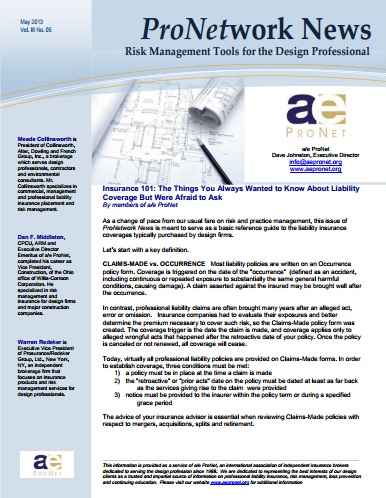
pronetworknews201305This issue of ProNetwork News is meant to serve as a basic reference guide to the liability insurance coverages typically purchased by design firms.

Let’s start with a key definition.

CLAIMS-MADE vs. OCCURRENCE

Most liability policies are written on an Occurrence policy form. Coverage is triggered on the date of the “occurrence” (defined as an accident, including continuous or repeated exposure to substantially the same general harmful conditions, causing damage). A claim asserted against the insured may be brought well after the occurrence.

In contrast, professional liability claims are often brought many years after an alleged act, error or omission. Insurance companies had to evaluate their exposures and better determine the premium necessary to cover such risk, so the Claims-Made policy form was created. The coverage trigger is the date the claim is made, and coverage applies only to alleged wrongful acts that happened after the retroactive date of your policy. Once the policy is canceled or not renewed, all coverage will cease.

Today, virtually all professional liability policies are provided on Claims-Made forms. In order to establish coverage, three conditions must be met:

  1. a policy must be in place at the time a claim is made
  2. the “retroactive” or “prior acts” date on the policy must be dated at least as far back as the services giving rise to the claim were provided
  3. notice must be provided to the insurer within the policy term or during a specified grace period

The advice of your insurance advisor is essential when reviewing Claims-Made policies with respect to mergers, acquisitions, splits and retirement.

This has been an excerpt of the May 2013 issue of ProNetwork News. The newsletter goes on to deal with all types of liability coverage, including Professional Liability Insurance, Commercial General Liability Insurance, Owners and Contractors Protective Liability Insurance, Workers’ Compensation and Employers Liability Insurance, Umbrella Liability Insurance, Employment Practices Liability Insurance, Directors and Officers Liability Insurance, and many more! Download the full PDF version of the newsletter here. Continue reading “Insurance 101: The Things You Always Wanted to Know About Liability Coverage But Were Afraid to Ask”

insurance_policyMost architects and engineers are required to have General Liability and Business Property insurance coverage. The former shows up in most design contracts, while the latter is an essential part of a design firm’s office lease agreement.

Needless to say, we get several common questions regarding these coverages:

What is General Liability coverage? What is Business Property coverage? What’s the difference between these coverages/policies and a Business Owners Package (BOP) Policy?

In an effort to demystify some of the concepts and to provide a quick reference a/e ProNet gathered some of its finest insurance minds and put together this basic manual: Insurance 101 for Design Professionals. This is not intended to be an exhaustive source of information but rather a primer designed to answer basic questions and to put the reader on the right track if more information is needed. a/e ProNet strongly recommends that the reader seek advice from an agent or broker specialist who is best equipped to understand the exposures to loss of each individual design firm.

The following is an excerpt from our Insurance 101 page, specifically defining General Liability, Business Property, and Business Owners Package (BOP). Access the full set of policy and coverage terms on our website.

COMMERCIAL PACKAGE AND BUSINESS OWNER PACKAGE POLICIES   

Insurance companies will combine frequently requested coverages under one economical package known as Commercial Package Policies or Business Owners Policies (BOP). One policy is designed to include among other coverages:

  • General Liability
  • Commercial Property
  • Non-Owned/Hired Automobile
  • Valuable Papers and Records
  • Business Interruption/Business Income Equipment Breakdown
  • Accounts Receivable

BOPs tend to be prepackaged policies available to smaller firms with little flexibility (other than limits) on available coverages. Commercial Package policies are offered to larger firms and provide a wide range of coverage options. Insurance companies that offer these policies to design professionals may require the insured to maintain professional liability insurance as a prerequisite to obtaining a package policy. Continue reading “Insurance 101: General Liability, Commercial Property & the Business Owners Package Policy”

beazleypro_summerissueOne of the several excellent insurance companies a/e ProNet works with has a new risk management resource for their professional clients: Beazley Pro.

We think our readers will be most interested in the Claims Corner; three scenarios, three discussions, three lessons learned. An example of a claim outlined in the Summer 2013 issue…

Engineer granted rare summary judgement

Facts:  After sustaining serious injuries in a fall in a sports facility parking lot, the plaintiff sued the property owner, who in turn filed a third-party action against our insured, an engineer. This suit against the engineer alleged that deficiencies and code violations in his design of the facility’s parking lot (specifically its handicap access ramp and lighting) were to blame for the fall. A site visit revealed that the lighting and lighting tower location in the parking lot were not as the engineer had specified. During deposition, the paving contractor affirmed that he used the engineer’s plan for pricing only, not for construction. Hence, there was no causal connection between any design deficiencies in the engineer’s plans and the plaintiff’s serious fall and injuries. Counsel moved for summary judgment, which was granted in full. Continue reading “A New A&E Resource: Beazley Pro Inaugural Issue”

aepronet_sda

In May this year, the Society for Design Administration (SDA), the nation’s largest professional organization for architectural and engineering design firm administrators and managers, announced its endorsement of a/e ProNet.

The proper management of professional risk factors such as contract administration, project administration, and document management are known factors in reducing professional risk in a/e firms.  Both SDA and a/e ProNet are dedicated to providing a/e firms the necessary tools to better manage risk and improve firm management. ~ Deborah A Gill, CPA, CGMA, CDFA, 2013 SDA President

As announced in the June/July 2013 issue of SDA Today, “a/e ProNet will pay one half of a new SDA member’s dues if that member’s insurance agent belongs to a/e ProNet… Chapters can partner with the local broker and reach out to principals and managers in their network.”

a/e ProNet and the SDA will also collaborate on a number of educational events, including the SDA’s annual EDSymposium conference. Last year, past a/e ProNet President, Leslie Pancoast, made two presentations at EDSymposium12 in Portland, Oregon, and current a/e ProNet President Jeff Todd spoke at EDSymposium13 in Williamsburg, Virginia earlier this year.

We look forward to a long and successful partnership with the SDA.

Looking for a convenient way to fulfilll your AIA Continuing Education credit requirements? a/e ProNet can help.

In the past few years, a/e ProNet has published two risk management guides for the design industry: Risk Management & Contract Guide for Design Professionals and Risk Management for Design Professionals in a World of Change. Both include courses at the back of the book, which have just been renewed with the AIA for credit for an additional 3 years.

Our books and access to the courses are available for purchase on our website, but you can receive a discount for both by requesting copies from your a/e ProNet broker. (And if your broker isn’t an a/e ProNet member, call your local a/e ProNet broker today!)

Read on for details about both contract review guides… Continue reading “Need CE Credits? a/e ProNet’s Contract Review Guides Can Help”

ProNetworkNews_2013AprilIn•dem•ni•fy Verb.

• Compensate (someone) for harm or loss.
• Secure (someone) against legal responsibility for their actions.

Imagine a case where an engineering firm was found to have had an expensive duty to defend claims asserted against a developer, even after the engineer’s performance was judged not to have violated the professional standard of care. That was the decision three years ago, in the California Court of Appeals in UDC – Universal Development L.P. v. CH2M Hill. In fact, that case extended another one, decided two years earlier in the California State Supreme Court. (Crawford v. Weather Shield Mfg., Inc.). That decision held that the duty to defend was incurred the moment that the indemnitee (the party that the design firm was contractually bound to indemnify) tendered its defense to the design firm.

Candidly, the indemnity provision underlying the UDC v. CH2M Hill decision was long and rambling, repetitive, and ambiguous. That’s what opened the door to the expansive (and expensive) legal interpretation. The clear message to design professionals was: if you do not want to take on the extensive defense and indemnity obligations implied or required by statute and case law, you must be clear. Further, the longer and more confusing an indemnity provision is, the more likely it is to receive an expansive reading.

The point of this article is to provide design professionals with a simple, three-step evaluation and corresponding “scoring” model to evaluate and improve the indemnity obligations it receives. Continue reading “Making the Grade: Testing Design Professional Indemnity Obligations”