Excerpted from the August 2012 issue of ProNetwork News:

Commissioning is a quality-oriented process for achieving, verifying, and documenting that the performance of facilities and systems meets defined objectives and criteria. It is a quality-based method that is adopted by the building Owner to achieve successful construction, and it is not intended to be an additional layer of construction or project management. When applied comprehensively, the purpose is to reduce the overall cost of a construction project and increase long-term value to the building owners, occupants, and users, better ensuring reliability of performance.

New Building Commissioning (Cx)

The purpose of New Building Commissioning (Cx) is to facilitate and verify proper system performance of a new building. The Process begins at project inception (during the Pre-Design Phase) and continues for the life of the facility (through the Occupancy and Operations Phase).

Why should Building Commissioning be done?

ASHRAE performed a study of 60 commercial buildings and found that more than half suffered temperature control problems, 40% had problems with HVAC equipment and one-third had sensors that were not operating properly. Amazingly, 15% of the buildings were actually missing specified equipment.

The Commissioning Process is intended to reduce the project capital cost through the first year of operation. It also reduces the life-cycle cost of the facility. By utilizing this process a fully functional, fine-tuned facility is provided, with complete documentation of its systems/assemblies, and with operators and maintenance personnel fully trained.

Building commissioning is of greatest value to the owner when it provides a means of continuously communicating their building systems criteria and rigorously verifying compliance with them, throughout the many phases of design and construction.

Prior to design, the Commissioning Authority (CxA) will assist the Owner in evaluating the facility’s requirements regarding such issues as energy conservation, indoor environment, staff training, and operation and maintenance. Continue reading “Building Commissioning: Process Types & Definitions”

Getting Paid For Design Services

The last few years have been challenging for many design firms. Adding fuel to this fire, many firms are having difficulty obtaining payment for their services. In a recent and ongoing SmartRisk Survey: 81% indicated trouble with getting paid. Successful account receivable programs do not have to be time consuming or daunting. By implementing some straightforward practices, a firm can implement an effective program that gets invoices paid on time along with maintaining a positive relationship with clients.

Establishing Financial Expectations. In an initial meeting with clients, explain in a clear and concise manner exactly what your services will be and the value you bring to the project, along with clearly stating your compensation terms. Your communication should be clear in establishing the financial expectations with the client. At this face-to-face meeting, you will obtain a sense of the client’s financial capability and ability to pay for your services. If you don’t get that warm and fuzzy financial feeling, this is the time to walk away.

Contract Agreement. The boundaries discussed at the initial meeting should be outlined in the contract agreement. Include a specific scope of services for the project, associated fees, expenses and cost of additional services. In basic terms, the agreement should explicitly state your client owes you money for services you will be rendering. The agreement should also specify the terms of payment, including any payment in advance of services. Continue reading “Getting Paid For Design Services”

This week, 46 a/e ProNet members from 27 member agencies are expected to attend our annual meeting in Chicago, Illinois. Over the course of two and half days, twelve top-tier Professional Liability insurance companies will present to our membership. Each company will take this opportunity to announce policy form changes, new endorsements, and pricing expectations for the coming year; as well, they will alert us to industry trends surrounding claims and risk management.

Because a/e ProNet brokers are independent, that-is, not tied to any single insurance company, the insurance companies sending representatives to this event know that they are in competition for our business. It is in their best interest to make their programs as comprehensive and beneficial  to our clients as possible. The companies attending this event include: RLITravelersVictor O. Schinnerer, Liberty, BeazleyCatlinHCCHanover, Navigators, Insight, All Risks, and AXIS.

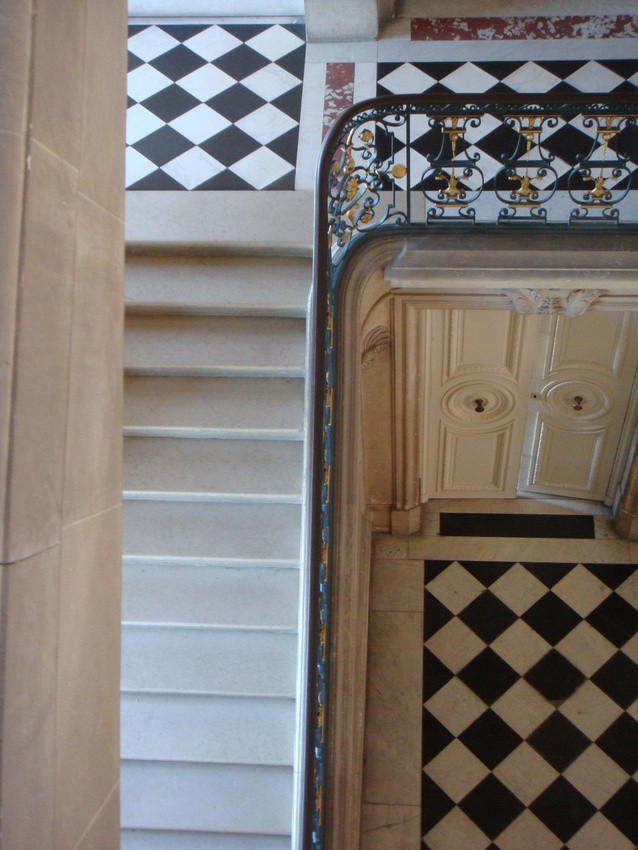
Our Thursday night reception for members and insurance company representatives will be held at a new venue this year: The Grand Army of the Republic (GAR) Rotunda at the Chicago Cultural Center.

Our clients are architects and engineers, and we appreciate what they do today, as well as what they have created in the past. We chose the Chicago Cultural Center, opened in 1897, because it is “one of the city’s most popular attractions and is considered one of the most comprehensive arts showcases in the United States.” In other words, it’s beautiful! A Chicago landmark, located in the Loop, across Michigan Avenue from Millennium Park, the GAR Memorial consists of a large hall and rotunda in the north wing of the building. The hall is “faced with deep green Vermont marble, broken by a series of arches for windows and mahogany doors. The rotunda features 30-foot walls of Knoxville pink marble, mosaic floor, and a fine, stained-glass dome in Renaissance pattern by the firm of Healy and Millet.”

If you have questions about this meeting, or a question about a/e ProNet, don’t hesitate to contact us. You can also find your local a/e ProNet broker through our website.

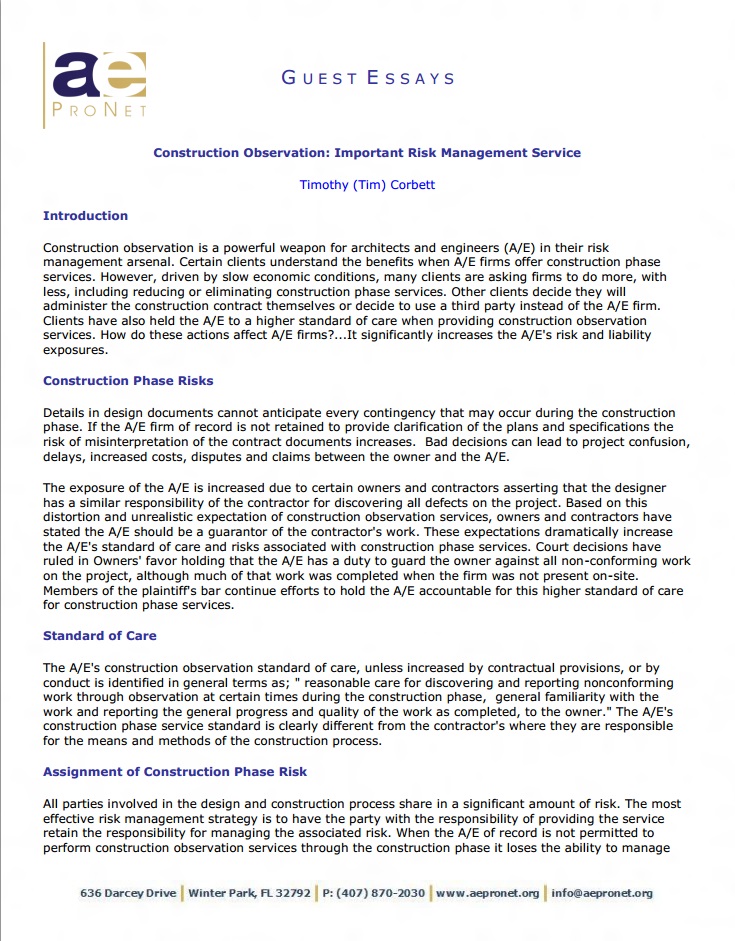
Construction observation is a powerful weapon for architects and engineers (A/E) in their risk management arsenal. Certain clients understand the benefits when A/E firms offer construction phase services. However, driven by slow economic conditions, many clients are asking firms to do more, with less, including reducing or eliminating construction phase services. Other clients decide they will administer the construction contract themselves or decide to use a third party instead of the A/E firm.

Clients have also held the A/E to a higher standard of care when providing construction observation services. How do these actions affect A/E firms? It significantly increases the A/E’s risk and liability exposures.

Construction Phase Risks

Details in design documents cannot anticipate every contingency that may occur during the construction phase. If the A/E firm of record is not retained to provide clarification of the plans and specifications the risk of misinterpretation of the contract documents increases.  Bad decisions can lead to project confusion, delays, increased costs, disputes and claims between the owner and the A/E.

The exposure of the A/E is increased due to certain owners and contractors asserting that the designer has a similar responsibility of the contractor for discovering all defects on the project. Based on this distortion and unrealistic expectation of construction observation services, owners and contractors have stated the A/E should be a guarantor of the contractor’s work. These expectations dramatically increase the A/E’s standard of care and risks associated with construction phase services. Court decisions have ruled in Owners’ favor holding that the A/E has a duty to guard the owner against all non-conforming work on the project, although much of that work was completed when the firm was not present on-site. Members of the plaintiff’s bar continue efforts to hold the A/E accountable for this higher standard of care for construction phase services. Continue reading “Construction Observation: Important Risk Management Service”

The Perspective of the Fire Protection Engineer 

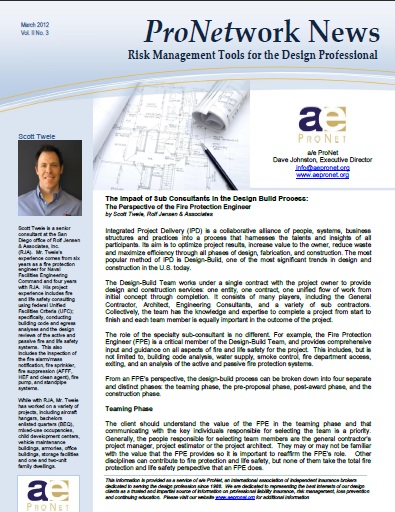
Integrated Project Delivery (IPD) is a collaborative alliance of people, systems, business structures and practices into a process that harnesses the talents and insights of all participants. Its aim is to optimize project results, increase value to the owner, reduce waste and maximize efficiency through all phases of design, fabrication, and construction. The most popular method of IPD is Design-Build, one of the most significant trends in design and construction in the U.S. today.

The Design-Build Team works under a single contract with the project owner to provide design and construction services: one entity, one contract, one unified flow of work from initial concept through completion. It consists of many players, including the General Contractor, Architect, Engineering Consultants, and a variety of sub contractors. Collectively, the team has the knowledge and expertise to complete a project from start to finish and each team member is equally important in the outcome of the project.

The role of the specialty sub-consultant is no different. For example, the Fire Protection Engineer (FPE) is a critical member of the Design-Build Team, and provides comprehensive input and guidance on all aspects of fire and life safety for the project. This includes, but is not limited to, building code analysis, water supply, smoke control, fire department access, exiting, and an analysis of the active and passive fire protection systems.

From an FPE’s perspective, the design-build process can be broken down into four separate and distinct phases: the teaming phase, the pre-proposal phase, post-award phase, and the construction phase.

Teaming Phase

The client should understand the value of the FPE in the teaming phase and that communicating with the key individuals responsible for selecting the team is a priority. Generally, the people responsible for selecting team members are the general contractor’s project manager, project estimator or the project architect. They may or may not be familiar with the value that the FPE provides so it is important to reaffirm the FPE’s role. Other disciplines can contribute to fire protection and life safety, but none of them take the total fire protection and life safety perspective that an FPE does. Continue reading “The Impact of Sub Consultants in the Design Build Process”

The most common refrain I hear when talking to clients about Contract Review and Administration is: “I only sign a standard contract.”

Most clients feel there is no reason for contracts to be reviewed prior to signing, because they only sign a standard contract. Unfortunately, the only standard contract I ever see is one in which an owner or client uses and wants their consultants and contractors to sign. Ironically, one of the few things that makes any contract a “standard contract”…is the omni-present and onerous broad hold harmless/indemnity and defense clause.

Contract Review and Administration is probably one of the most important aspects of a prudent risk management and loss prevention program. A contract that any Contractor or Consultant signs should identify their rights and responsibilities to the owner and third parties. All of this should be determined at the “request-for-proposal” stage. If done here…it allows the Contractor or Consultant to identify, evaluate and treat the risks in the Owner or Client standard contract. Please remember that no one is putting a gun to the Contractor’s or Consultant’s head when he or she signs the contract; so it’s absolutely essential that the Contractor or Consultant knows what he is signing and what his rights and responsibilities are when negotiating for future work.

The prudent Contractor or Consultant should discuss all contracts with their counsel and agent before signing. Some general practice tips to consider when reviewing contracts are:

  • Scope of services: Think about whether the contract is exactly what you thought is was going to be in terms of encompassing more or less services, added responsibilities or services outside your area of expertise. It is also wise to describe things you are not doing to reduce the potential for misunderstandings.
  • Change orders: Find out if the Owner is allowed to change the scope of work once under way, and, if so, under what conditions. For instance, look at what input or options you have and what time frame you have to consider this.
  • Warranties and Guarantees and Performance Standards: First, you have to know if there are any. Try not to assume any and don’t agree to unreasonable ones…if you must assume any! Don’t forget that all professional liability policies exclude the assumption of liability policies which turns out to be a warranty or guarantee or performance guarantees.
  • Compliance with all laws, regulations, etc.: These responsibilities can be difficult to live up to since no one knows what all the laws, regulations, ordinances, rules, etc. are, much less how to comply with all of them. Continue reading “Is there such a thing as a Standard Contract?”

To Hire or Not To Hire?

As the American economy recovers, all eyes are on the construction design industry, a key indicator of the economic climate. Design professionals are preparing for the next phase of recovery in a variety of ways. Not only is there the hope that new projects will begin to come in soon, but there is a backlog of projects which began two or three years ago, but stalled. These projects have been pending in different stages, some abandoned completely, many without funding to continue. Unfreezing from that limbo would mean the potential for immediate work in many design firms, and that work could require additional hands.

In the April issue of CSPE Online, The Official Newsletter of the California Society of Professional Engineers, a/e ProNet Member Reno Caldwell published a column which addresses this exact scenario. For architects, engineers, consultants, and other construction industry professionals, this will bring up one very important question:

To Hire or Not to Hire?

Excerpt:

“Raise your hand if you were thinking of hiring someone this time last year.  Had I posed this question to a group of business owners in April 2011, I am confident not too many hands would have gone up.  The following two questions may still be far fetched, but if the tide begins turn and the project light-switch flicks up it’s worth asking both:

  1. When will your firm begin hiring?
  2. Will errors and omissions liability affect your hiring decision?

“You may be thinking that errors and omissions liability has nothing to do with a hiring decision.  Are you sure?  Most business owners understand the importance of balancing risk for the potential reward.   The term ‘reward’ probably seems distant, but many design and engineering firms have multiple projects that have long been in a perpetual ‘waiting’ mode.  Your office could get busy very quickly should these projects become active within a few months of each other, and as new projects come in the door.   Yes, this will be a happy day!

“However, many business owners have depleted their retirement savings in order to keep the lights on and doors open over the past three years.  It will be very tempting to replenish the bank account when the economy improves.   The risk management pendulum could swing quickly from ‘low risk / low reward’ to ‘high reward without considering risk.’  This move would be understandably tempting, but I urge you to take a closer look beforehand.”

To continue reading (and to get some valuable advice) visit IOA Insurance Services’ website for the full text of this article, as well as a downloadable PDF.

About the Author: Reno Caldwell is Vice President of IOA Insurance Services. He operates from the San Francisco Bay Area office in Pleasanton, CA, which he joined in 2007. He has specialized in providing professional liability insurance for design professionals, construction managers, law offices and other professional consultants since 1996. Reno is an affiliate member of the California Society of Professional Engineers; IOA is the exclusive broker of CSPE’s endorsed professional liability insurance program. reno.caldwell@ioausa.com

Longtime design industry advocate, a/e ProNet, announced this week that ProNet President Leslie Pancoast will make a presentation at EDSYMPOSIUM12, the 42nd annual education conference hosted by the Society for Design Administration (SDA), an affiliate of The American Institute of Architects.

For more than 50 years, the SDA has promoted education and best practices for design firm administrative personnel. EDSYMPOSIUM12 will take place from May 2-5 at the Embassy Suites Hotel in Portland, Oregon. a/e ProNet will sponsor Saturday’s luncheon, where Pancoast will make a two-fold presentation: Introduction to a/e ProNet and Professional Liability—Coverages, Nuances and Endorsements. SDA members will learn more about a/e ProNet and its active support for the design industry, as well as receive a brief overview of professional liability coverage and the standard endorsements available from most professional liability insurance providers for architects and engineers.

About Leslie Pancoast

Pancoast has specialized in the insurance needs of architects, engineers and other design consultants for more than 20 years. She is a Managing Partner of Insurance Office of America (IOA), one of the largest privately-held insurance agencies in the country. She is also the Branch Manager of IOA’s San Francisco Bay Area office, operating in California as IOA Insurance Services, which she opened in 2005. Pancoast has earned the designations of Commercial Insurance Counselor (CIC) and Registered Professional Liability Underwriter (RPLU). She has been an active board member of a/e ProNet since 2005, and currently serves as the membership’s President.

About a/e ProNet

Established in 1988, a/e ProNet is a national network of specialist brokers. The group focuses on providing educational resources and risk management services to its members’ clients. Its member brokers represent a combined annual professional liability premium volume exceeding $300 million, giving top-tier insurance companies a major incentive to work closely with a/e ProNet to enhance their various a/e programs.

As well, a/e ProNet makes a wide range of Risk Management resources available to all design professionals via their website, including ProNet Practice Notes, Guest Essays, ProNetwork News, Contract Concerns, Typical Coverages, and Frequently Asked Questions.

a/e ProNet is excited about the opportunity to partner with the SDA in order to provide this value-added educational resource to design firm administrative personnel across the country.

Additional information is available about a/e ProNet by visiting their website, following them on Twitter, and/or Liking their Facebook page.

The following is an excerpt for the most recent ProNet Guest Essay by Frank L. Pohl, Esq. and James C. Washburn, Esq.:

“Frequently, general contractors will work with the same subcontractor or supplier on two separate, unrelated projects. When that happens, the situation may arise that on the first project (Project A), the subcontractor defaults on its contract, resulting in a back-charge that exceeds the subcontractor’s contract balance, i.e. the subcontractor owes the general contractor money. On the second project (Project B), the subcontractor satisfactorily completed its work and is due money from the general contractor. It may seem obvious that the general contractor would have a right of set-off, allowing the general contractor to deduct the amount due from the subcontractor on Project A from the amount that the general contractor otherwise owes the subcontractor on Project B. Seemingly, the general contractor should only have to pay the net difference or be able to avoid paying the subcontractor anything if the back-charge on Project A exceeds the amount due on Project B. However, as outlined in this article, that seemingly straight-forward right to “net out” the competing claims might not always be available.

“There are several different factors that can frustrate the general contractor’s right of set-off. In some jurisdictions, state statutes may prohibit the general contractor from withholding from the subcontractor the amounts received from the owner for the subcontractor’s work, such statutes holding that those funds are held in trust for the benefit of the subcontractor. Some states might even find the withholding of funds received by the owner for the subcontractor’s work to be statutorily criminal. On projects covered by a payment bond, courts in some jurisdictions have held that even if the general contractor has a contractual right to set-off, the Surety may not. As a result, in those jurisdictions, notwithstanding the contractor’s contractual right of set-off, the subcontractor may be entitled to recover the full amount on Project B (from our scenario above) from the Surety without any deduction of the amounts the subcontractor owes on Project A. Given that the general contractor must almost always indemnify the Surety, such a result has the practical effect of eliminating the contractual benefit of a right of set-off. Additionally, in certain circumstances, by the discretion afforded to judges under the rules of civil procedure, courts have required the two competing claims to be handled by separate lawsuits independently and without regard to the general contractor’s claim of set-off. This article discusses these scenarios and others that impact the right of set-off.”

To continue reading, download a the full PDF version of this article at our website.

About the Authors:

Frank L. Pohl, Esq. and James C. Washburn, Esq. are partners in the law firm of Pohl & Short, P.A. in Winter Park, Florida.  Pohl & Short, P.A. is a business boutique law firm concentrating in four main areas of business law: commercial litigation, real estate law, corporate law and trusts and estates.  Mr. Pohl has been advising clients involved in all aspects of real estate development for over 30 years.  Mr. Washburn practices construction law and is Board Certified in Construction Law by The Florida Bar.

This article is intended for general discussion of the subject, and should not be mistaken for legal advice. Readers are cautioned to consult appropriate advisors for advice applicable to their individual circumstances.